
Odisha Part 7: The Rajarani Temple, Bhubaneshwar

The Rajarani Temple in Bhubaneshwar gets its name from the stone used to build it - the red and yellow sandstone used here is locally called Rajarani. This temple was once known as the Indreshwara temple, which is mentioned in the Ekamra Purana, which tells us about the temples of Bhubaneshwar, which was then known as Ekamra Kshetra. Today, the temple stands in a well-maintained lawn, and is the only ticketed monument within the city. The temple is built in the typical Kalinga style, with the tall curvilinear shikara over the garbagruha, and a jagamohana connected to it. The temple is believed to date back to the 11th century, and is most well known for its sculptures.
The entrance to the temple has two pillars with a Naga couple protecting the sanctum, holding garlands in their hands. The base of the pillar shows 3 lions standing over 3 elephants, a typical motif in temples of this region during this period. On the other side of the pillar is a horse and rider, and the two motifs are separated by a tree.
Above the Nagas, on the lintel can be seen the Navagrahas – the nine planets, starting with Surya on the left, and ending with Rahu and Ketu.
The doorway to the Jagamohana has two Shaiva Dwarapalas, as can be seen by the trishuls they wield, thus indicating that this is a Shaiva temple. This is especially helpful, considering that there is no idol or linga inside the temple at present. This is further confirmed by the presence of Lakulisha on the lintel above the door, indicating that this is a temple built by the Pasupata sect. The Lakulisha panel shows 4 of his disciples by his side, and also a row of disciples on the side, though they are only visible on the right… the left panel is damaged.
The outer side of the Jagamohana is bare, probably because it was damaged and was restored at some point of time. Most of the sculptures on the outside of the garbagruha and the Rekha deula are relatively intact, and this is what makes this temple special.
The temple is known for two kinds of sculptures – the Ashtadikpalas, or the guardians of the eight directions, and the apsaras or surasundaris. Like all other temples of this period, the temple has other sculptures as well, such as mithunas, or erotic couples, as well as other depictions of deities, but this is one of the few temples where the dikpalas are almost intact, and placed in their correct positions on the temple walls.
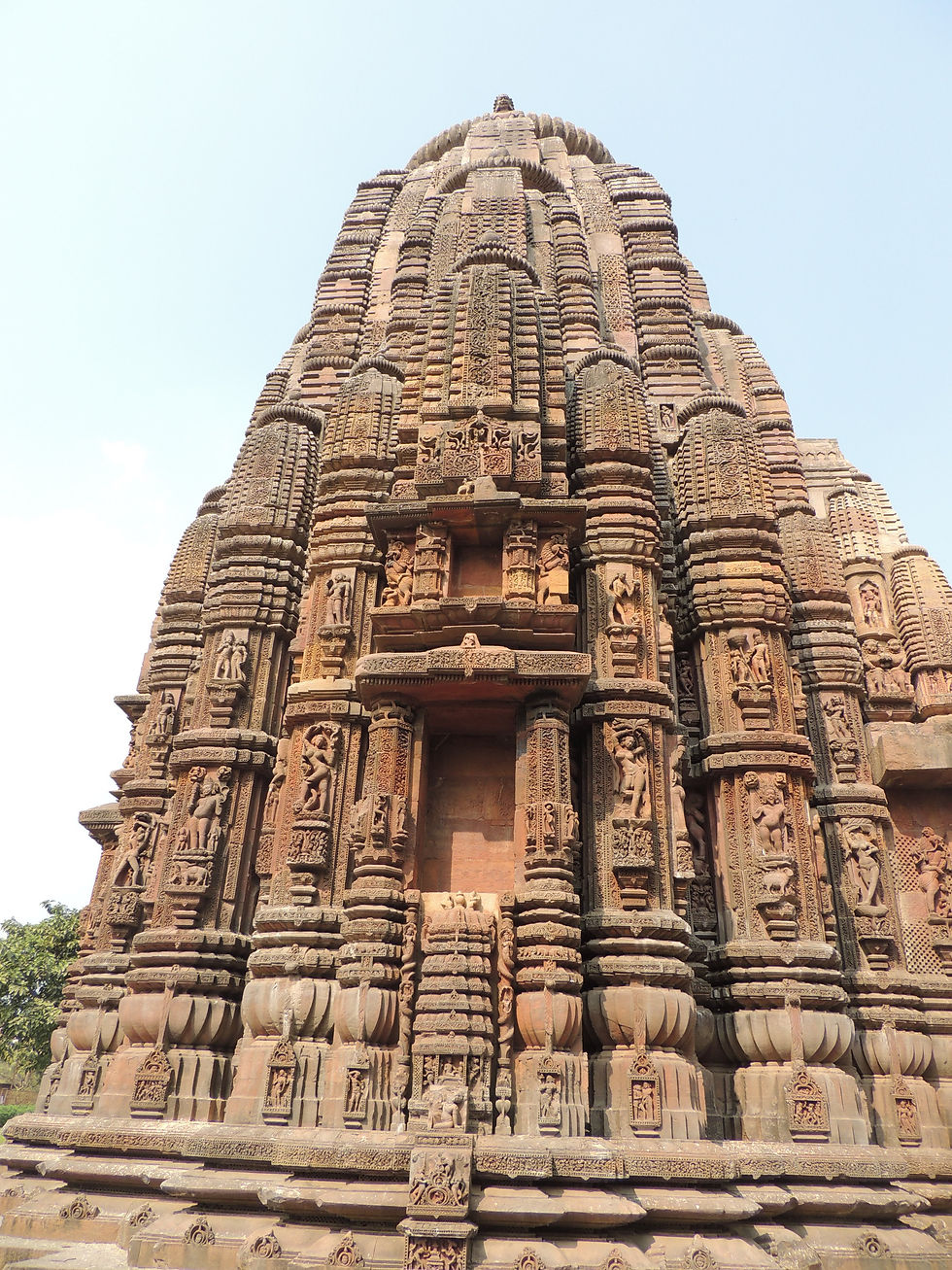
The above photo shows one side of the temple, with the placement of the sculptures, to give you an indication of how they actually look. Unfortunately, the main sculptures in the niches, which would probably have been different depictions of Shiva, are long gone. Let us now look at the sculptures that do exist, starting with the Ashtadikapalas.
The Ashtadikpalas, as I have already mentioned, are the guardians of the eight directions. Each one faces the direction they guard, and thus are easily identified.
Let us start with Agni, the guardian of the Southeast. Agni is easily identified by the flames that surround him. He also has a pot belly, and a beard, showing that he is an ancient God, and he stands on a ram, his vehicle. The artisan of this temple has taken creative liberties, depicting Agni standing on a lotus, while the ram stands below it. This depiction only increases the beauty of the sculpture, and the temple as a whole. All the dikpalas are shown in this manner here.

The next is Yama, the guardian of the South. Yama stands on a buffalo, with a noose in his hand.

Next is Nritti, guardian of the Southwest. Nritti here is shown standing over a human, holding a skull in his hand.

The guardian of the west is Varuna. He also holds a noose, and instead of standing over his vehicle, we can see it on his right – a crocodile. Below him is a stylized depiction of water and waves, since he is also the Lord of water and oceans.

The guardian of the northwest is Vayu, the god of wind. He stands on a long stalk, and holds something in his hand that is seen flying in the wind. He is usually seen with a flag or a cloth that is seen flying behind him, or over his head, but here the depiction is slightly different, once again probably artistic liberty taken by the sculptor.
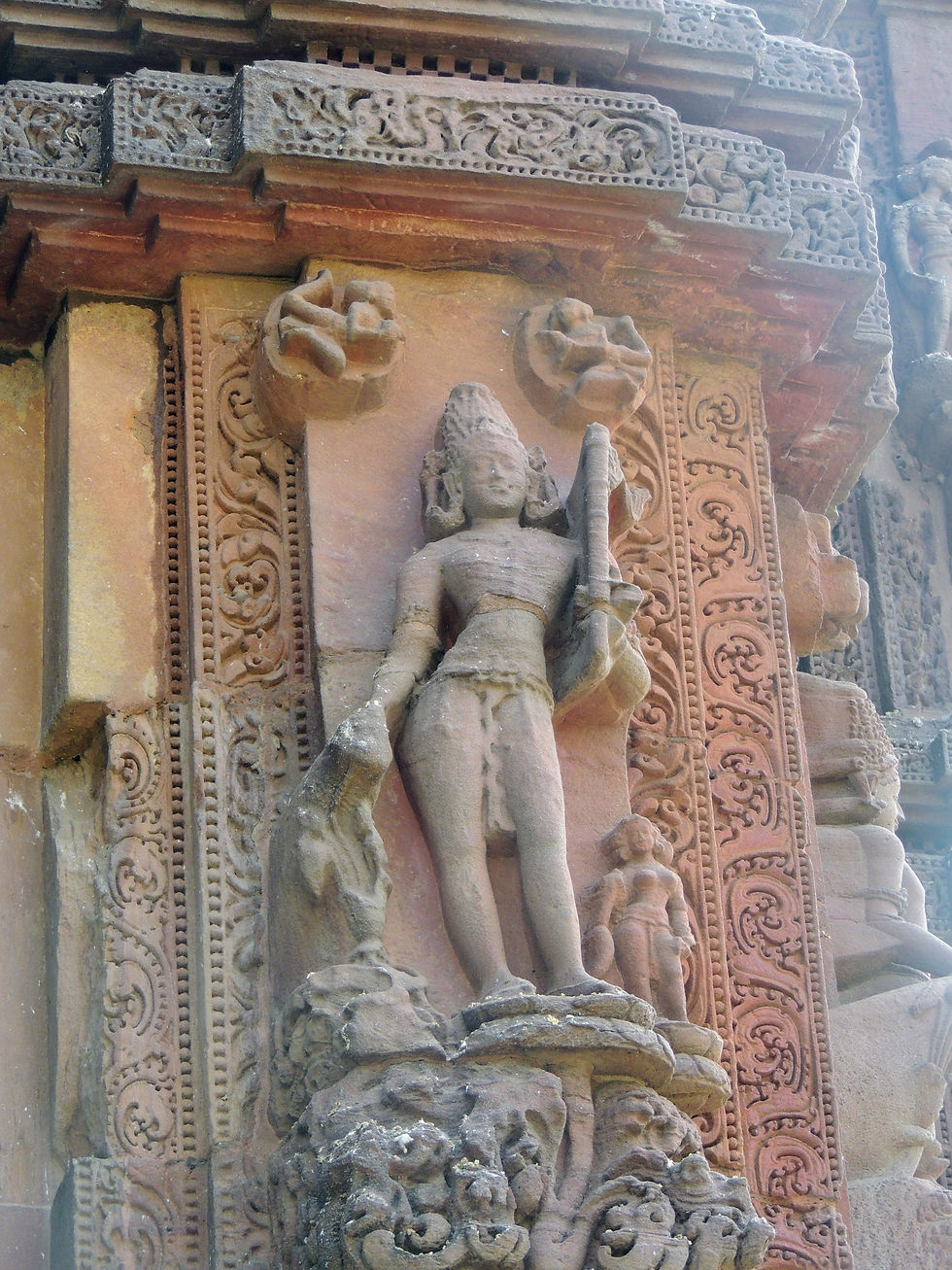
Next is Kubera, guardian of the North. Kubera is also the god of wealth, and here he is seen with a bag, filled with what appear to be jewels or gems. The panel below him also shows some rounded objects, probably used to store wealth.

The guardian of the Northeast is Ishana, who is Shiva himself. Here, this is one of the more damaged sculptures, and one can barely see his face. But he can be identified by the skeleton which stands next to him.
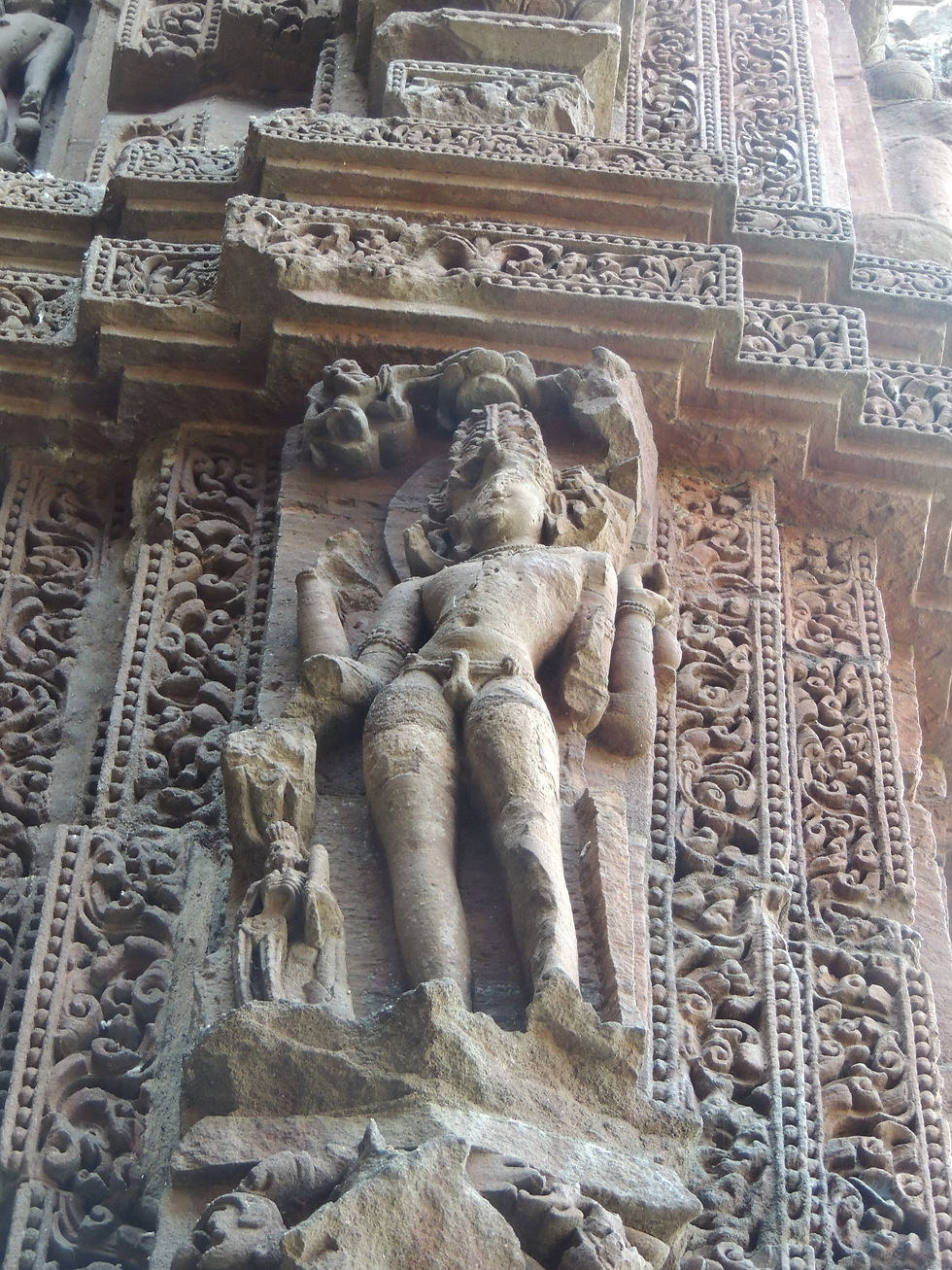
The final dikpala is Indra, the king of the gods, the god of rains. And the guardian of the east. He is shown on an elephant, and traces of his weapon, the Vajra, can be seen near him, but unfortunately, I didn’t get a good photo of him, so apologies for the incomplete set of images.
The apsaras or surasundaris here are a beautiful bunch, shown standing next to trees, holding on to a branch like the shalabhanjikas seen in Buddhist sculpture. Considering the long and close connection of this region with Buddhism, this depiction is not surprising at all.
Moving on to the smaller sculptures seen in the temple, let us begin with this one, showing the scale, or the size of these sculptures, to give you a better context to appreciate them.

My favourite is this one of Natesha, surrounded by dancers, holding on to the snake with two of his hands above his head.

This other one shows a court scene, probably depicting the king. Again, the detail is admirable, considering the size.

Here is an image of the entire panel, which shows a miniature model of the temple itself..

The Rajarani temple is the perfect temple to begin a tour of the temples of Bhubaneshwar. It gives you an idea of what to expect, and what to look out for, at the other temples.
Other posts on Odisha -


Comments