
Odisha - Part 12 : The Buddhist Heritage of Odisha

The story of Buddhism in Odisha begins at Dhauli, near Bhubaneshwar. Dhauli is believed to be the location of the famed Kalinga war, and the site of Ashoka’s conversion to Buddhism. Dhauli today is a popular pilgrim and tourist place, and the recent stupa built there draws huge crowds. Very near, in a neatly maintained garden are two objects of great interest to the historian – an Ashokan edict, and a rock cut elephant. Dating back to the 3rd century BCE, they are the earliest references to Buddhism in Odisha. For some strange reason, my photos of both, the edict and the elephant didn’t turn out too well, so let me settle with this pic of a section of the inscription.

Since Dhauli is the site of Ashoka’s conversion, it is clear that there were Buddhists here before he arrived. However, Buddhism itself doesn’t seem to have been very popular during that period, since we see more evidence of Jainism rather than Buddhism. Ashoka went on to spread his new religion across the subcontinent, but in Odisha itself, royal patronage seems to have favoured the Jains and later the different sects of Hinduism, as we can see from the sites of Udaygiri and Khandgiri, as well as the numerous temples dating across centuries.
It is interesting however, to note that, by the 6th century, Buddhism was in decline across the country, but in Odisha, it got a new beginning, under the reign of the Bhaumakaras in the 8th century. Buddhism however, was no longer the Buddhism practiced by Ashoka. It had evolved into the later forms of the religion that we know as Mahayana and Vajrayana. While in the earlier, Theravada form of Buddhism (I dislike the word Hinayana, and prefer to use the word Theravada for early Buddhism), the Buddha alone was the focus of the religion, and rituals were few, Mahayana brought in the concept of Bodhisattvas, who aided the seekers in their efforts, and Vajrayana, an esoteric form of Buddhism brought in various deities, who bestowed their boons on the seeker, to help him along his path. The word Vajrayana has many connotations, and the Vajra is equated with the thunderbolt, as well as the diamond. The association with the diamond is obviously more fascinating, and the word has been used to describe the 3 major Buddhist sites in Odisha from this period – Ratnagiri, Udaygiri and Lalitgiri. Together, these 3 sites are called the ‘Diamond Triangle’, and all 3 sites are must-visits for anyone with an interest in Buddhism.
On my first visit to Odisha, I had no time for these 3 sites, and skipped them. I had no intention of visiting them on my recent trip either, but Samhith was eager to see them, and so we headed out towards them from Bhubaneshwar, encouraged by our hosts at Svanir. I was plagued by health issues during this trip, and had no stamina to walk the extended distances to see the sites and appreciate them. So, I stuck to the museums at two of the sites (Ratnagiri and Lalitgiri), while Samhith explored the sites on his own. Most of the photos in this post are hence his, and I shall stick to talking, not of the sites as a whole, but of what I did see.
Ratnagiri
The first site we visited was Ratnagiri, and we elected to visit the museum first, and the site later, which turned out to be a good decision. Ratnagiri seems have been active from the 6th to the 12th century, particularly under the reign of the Bhaumakaras (8th to 10th century), who ruled from Jajpur. Ratnagiri shows evidence of Mahayana as well as Vajrayana, though there is a strong Tantric element present even in early sculptures. There are a lot of images of Padmapani Avalokiteshwara here, which shows a connection to the trade route with South-East Asia. Avalokiteshwara, incidentally, for those of you who didn’t know, is worshipped for safe passage, especially on the seas, and hence is the patron deity of Buddhist seafarers.
Sharing some sculptures from the museum that I found interesting…. Click on image to enlarge.
Walking down to the site, there is this enclosure filled with votive stupas. As is common from those dating to the Mahayana period, they all have imagery.

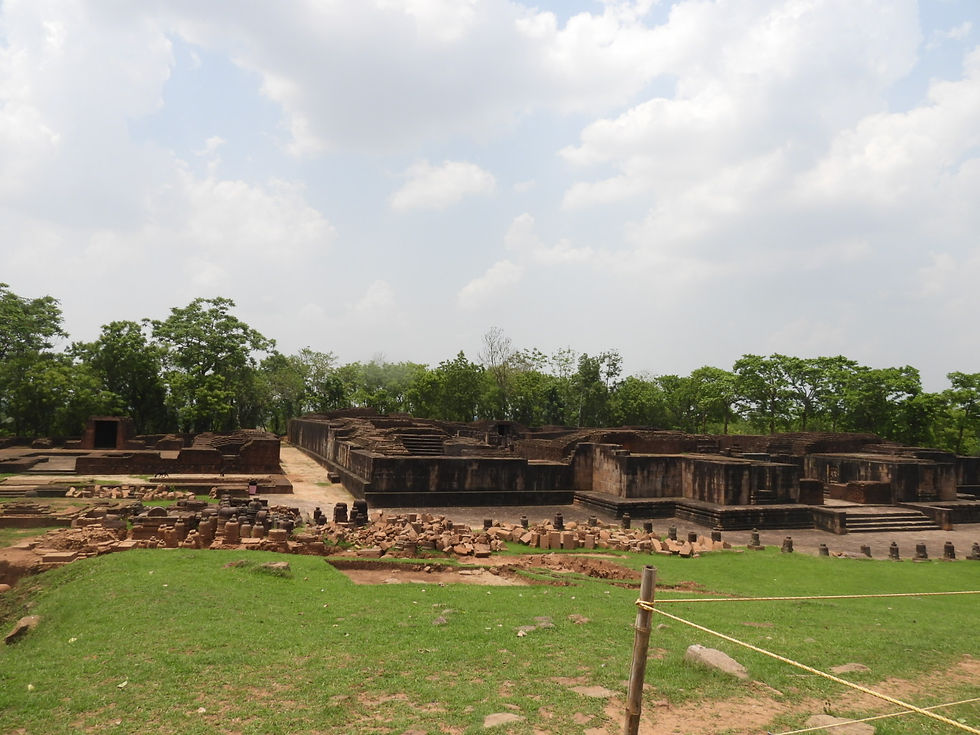
The site of the main vihara in Ratnagiri is impressive, and no photo can do justice to it. A few of the images remain in their niches, but most are either broken or have been moved. All along the walls we can see broken images, remnants of what once would have made for a very impressive and image-rich monastery, drawing monks and seekers from far and wide. Click on image to enlarge.
Outside, excavation is on, opposite the main vihara, and votive stupas and broken images are scattered all over the place. This was far more interesting and attractive than the well-preserved monastery, and while I rested under a tree, sitting on one of the broken stones which might have graced either a chaitya or a vihara, Samhith walked around, clicking photos, and talking to the men taking a break from their work.
It was fascinating to see this sight of curls peeping out from the ground, indicating the presence of a Buddha head buried underground. Going by the curvature that is seen, it must be quite a large sized sculpture.

These pictures, clicked from the top of the mound, show the entire site, giving us an idea of the vastness of the site. It hints at how big the Vihara must have been, in its time, and just how important.

This temple once stood over an earlier stupa, but has been transplanted, and entry is through the village, where this is now looked at as a Hindu temple.

Udaygiri
Our next halt was Udaygiri, and I was dead tired. So, while Samhith explored, I settled down to wait at one of the stalls outside the gate. The lady running the stall didn’t know any language other than Odia, and I didn’t know a word of the language, yet my time spent waiting wasn’t quite as boring as I would have imagined. Multiple people passing by (mostly vendors) started conversations, enquiring about why I was sitting outside, people asked about the number of kids I had, and why my husband wasn’t with me, what I did, and so on and so forth. They offered me food, which I respectfully declined, and they told me about their own families, their children, and the crowds that arrived from abroad during the peak season in winter. I found it extremely interesting, and also a little sad, that more foreigners visited these sites than Indians, and the Indians who did visit, came more to walk amidst the nicely manicured lawns, rather than to understand the rich heritage of this land. I also felt extremely sad for coming all the way, and being unable to explore the way I wanted to, but for now, I had to be content to see it through Samhith’s eyes. Click on images to enlarge.
Udaygiri, we know from inscriptions, was once known as Madhavapura Mahavihara. It was active from the 7th to the 12th century, once again in the reign of the Bhaumakaras.
From the sculptures, the Buddhism prevalent during this period appears to be Mahayana, with a strong Vajrayana influence.
What I found very interesting was a step well on the site. It made me wonder about how water was handled at different sites. We do know that water management systems existed at these sites, since we saw water channels inside every monastery we visited. However, this was the first time I saw a step well like this one.

Lalitgiri
The final stop in the Diamond triangle is Lalitgiri, and this site is most well-known for the relics found here. These relics are housed in a museum built for the purpose, and that is where we headed first.
Sharing a selection of images from the museum. Click on image to enlarge.
Lalitgiri is definitely a very interesting site. It is the oldest site in the Diamond triangle, and indeed, in the region itself. There are traces of continuous occupation, right from the post-Mauryan period (322-185 BCE), to the 13th century. Most of the excavated sites have been dated to the Bhaumakara period (8th to 10th century). However, discovery of potsherds with inscriptions helps push the date of occupation of this area, and presence of Buddhism, to the post—Mauryan period. From the archaeological finds, it is clear that Buddhism was active in this region, right from the Mauryan period to the 13th century, and that all forms of Buddhism – Theravada, Mahayana and Vajrayana – existed and flourished here.
The presence of the relics of the Buddha (now at the site museum), indicates that this was once a very important site for Buddhists.
Once again, having exhausted myself simply walking to the museum, I let Samhith explore the site on his own. A few photos from the site... click to expand
As I sat at the museum, waiting for Samhith to return, I reflected on the 3 sites I had visited (albeit only through their museums). Buddhism, it is evident, thrived in this region, right from the early period. Ashoka’s conversion to Buddhism would have added an impetus to the importance given to Buddhism and Buddhist monks in the region. However, the region in the immediate post-Mauryan period was dominated by Jainism (as we know from the Kharavela inscription). Hinduism, in some form or the other, would have existed all over the place. Hence, Buddhism was relegated to a relatively quiet presence, probably here at Lalitgiri, as well as a few other sites hidden amongst the mountains, on trade routes that led from the ports to the heartland.
Somewhere in the 8th century, with the arrival of the Bhaumakaras, Buddhism rose to importance again. Jainism was beginning to decline in the region, and the Jains were probably moving to other areas. Hinduism (Shaivism, Vaishnavism and Shaktism) were also on the rise, Shaivism centered around Bhubaneshwar (then Ekamra Kshetra), Vaishnavism thrived at Puri, and Shaktism existed in hidden corners across the region. Buddhism was changing too. The pure philosophy of Buddha was evolving, making the religion more attractive to the lay devotee. He could now worship Bodhisattvas, and to Tara, offer votive stupas either in gratitude or in prayer. As the devotees and patronage increased, the monasteries grew bigger, and more ornate. Tantrism was already popular in this region, as we know from the Shaiva as well as Shakta temples. The evolution of Mahayana to Vajrayana would have been easily accepted under these circumstances. The increased number of deities, the rituals, would have seemed familiar, and even logical, to the lay devotees, and Buddhism continued to thrive, till Islamic invasions forced the monks and the monasteries away from the region. The sites continued to be used – they were never really lost, like some of the other monuments in India – by a few scattered people, but disappeared from popular memory, till archaeological excavations opened them up to the world again.
All the 3 sites are well maintained, including the museums. There are facilities for washrooms, water, etc., for visitors. When we visited in early June 2025, we were the only visitors. I was told that the most visitors arrive in winter, and most are foreigners. What I missed most was the presence of guides. There wasn’t a single guide at any of the 3 sites. While I understand that we visited in off-season, there should be some arrangements for people like me who like to avoid the crowds. Audio guides would have helped immensely, for example. So, we had no choice but to stumble around and try to figure out what things were and how to explore it. It would have been easier for Samhith had I been able to go along, but since I couldn’t, he was almost completely lost, and dependent on the information boards, which were few. Most of what I have written about is from reading up about the sites extensively, and trying to correlate what I saw to what I read.
Information
The Diamond Triangle – Ratnagiri, Lalitgiri, Udaygiri – are roughly 100 Km from Bhubaneshwar.
All 3 sites can be visited on a day trip from Bhubaneshwar. Bhubaneshwar – Ratnagiri – Udaygiri – Lalitgiri is roughly a 5-hour round trip. Including the time taken to explore the monasteries, it can take the full day.
A round trip to these 3 sites from Jajpur takes roughly around 3 hours, so it is advisable to stay at Jajpur to cover these sites, as well as many others in the vicinity.
Be prepared to walk a lot. These are all extensively spread out. Washroom and water facilities are available at all the 3 sites, and they are reasonably clean.
There are only a few basic options for food. No big hotels or restaurants nearby, just small local hotels and shacks by the roadside, so go prepared.


This information is helpful for everyone.
Great blog! Your insights make travel planning much easier. Alpine Holiday Inn, the Best Luxury Hotel in Kufri, Shimla, seems like a reliable place for a memorable mountain vacation.
Very informative and well-written article. It explains the topic clearly and is easy to understand. Thanks for sharing such useful information.
reefmovers