
Odisha Part 10: Bhubaneshwar – the city of temples

Bhubaneshwar is often called the city of temples. It is impossible to know exactly how many temples there are, but it has been estimated that there might be over 700 temples in the city. This number, while impressive, is just a fraction of the original number, which, sometime in the 13th century, would have been about 7000. Wikipedia has a page dedicated to the Hindu temples of Bhubaneshwar, where 93 temples are listed. All these are ancient temples, built between the 7th and 13th centuries CE.

Bhubaneshwar was once known as Ekamra Kshetra, the sacred mango grove. We know this name from an inscription at the Ananta Vasudeva temple, which mentions the name of the place, and the main temple (that we now know as the Lingaraja temple) in the mango grove.

It is extremely interesting to note that the Ananta Vasudeva temple is the only temple to Lord Vishnu in this city.

Located very near the Lingaraja Temple, and the Bindusagar Lake, this temple is a must-visit, in this temple city. Unfortunately for me, the temple was under massive repairs when I visited, and we were barely able to get a glimpse of the gorgeousness here.
Most temples in the city are dedicated to Shiva. This indicates that the city was once an active centre of Shaiva worship. From the temples, it also appears that the primary Shaiva sect active during the entire period were the Pasupatas. The modern name of the city also derives from one of the names of Shiva – Tribhuvaneshwara, the Lord of the 3 worlds.
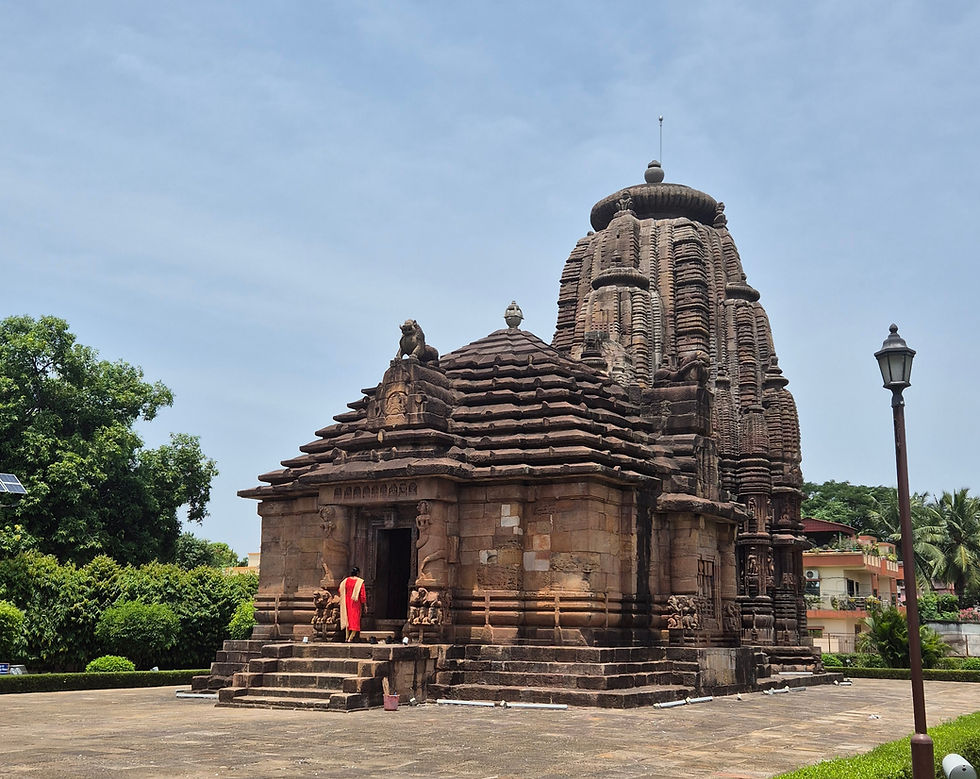
I have already written in great detail about two of the Shiva temples in Bhubaneshwar – the Rajarani temple, and the Parasurameshwara temple. The Sisireshwara temple, dated to the 8th century, is among the older ones in the city, and has a very impressive sculpture of Lakulisha, the founder of the Pasupata sect, surrounded by his disciples. Sadly, this temple is surrounded on 3 sides by encroachments, and only the most persistent visitor would even try to go around and see the sculptures on the other side. Needless to say, I did not attempt it.

The Mukteshwara temple (10th century CE) is well known, and is a gorgeous temple, both, architecturally, as well as sculpturally, but its most stunning sculptures are on the ceiling of the hall – one of the most stunning sets of Saptamatrikas I have ever seen, which is sadly, so badly lit, that taking any decent photos was impossible. The arch of the Mukteshwara temple is one of the most famous sights in Odisha, and this is certainly the most recognizable temple. The details are incredible, even on the outside. Click on the photos to see the details, the Natesa on the Vimana, the Nayika / Apsara with Veena , a group of ascetics, Ganga on the makara, and Yamuna on the tortoise.
There are interesting sculptures at various temples, either on the walls, in niches, or simply standing by, as if unsure of where they fit within the iconographical system of the temple, such as these images of Ganesha, Natesa and Skanda with peacock and rooster, all from the Mukteshwara temple complex.
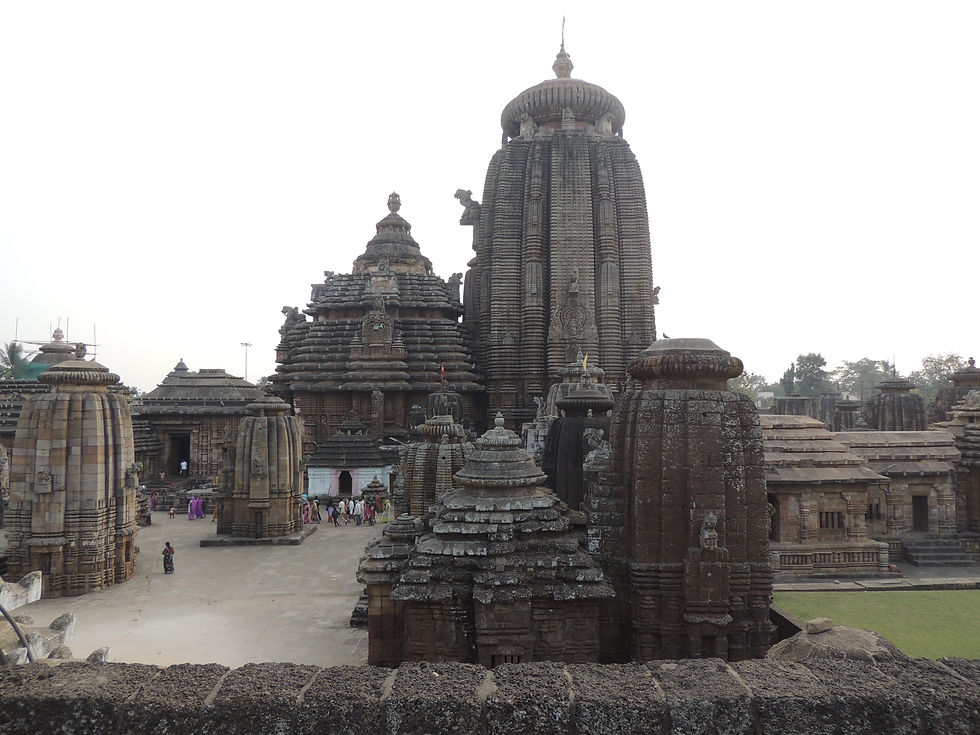
And then, there is the Lingaraja temple, the centre of the city, its heart. The main shrine, surrounded by the numerous smaller ones, can be chaotic, to say the least, but that is to be expected from a living temple. To truly see what the temple complex is like, though, one has to go to the platform provided outside the temple, from where one gets a bird’s eye view.
This structure, called the Jagati, on the Bindusagar Tank, is used for specific rituals, and reminded me of similar structures I have seen in the south.

While the city itself is predominantly Shaiva, there are plenty of Shakta temples in and around the city. The most intriguing among them is the Vaital temple, which I have already written about.
There are temples at every turn, most of them decently maintained, sculptures and carvings in various states of preservation. However, what I realized, during both my trips, is that visiting too many of these temples can get overwhelming. After the first few, the details start blending into each other, and I could no longer focus on minutiae, as I usually do. For example, we saw this one temple, where I remember seeing many of the dikpalas, mostly damaged, but still identifiable. But I hardly had the energy to do so…. Further, now, just 6 months down the line, I can’t even remember the name of this temple, which is very unusual for me.

One thing to remember while visiting Bhubaneshwar is that while today, the city is the capital of the state of Odisha, it was never the capital of ancient Utkala or Kalinga. Other cities in the region were capitals at different times. In a way, one can say that Bhubaneshwar is the spiritual capital of Odisha.
This city has attracted spiritual seekers for centuries. Pasupatas would have lived here, or nearby, in the wilderness, and the temples would have drawn not only the royal family, but also devotees from around the region. Puri would have been the centre of the Vaishnava movement, and the Shaktas were also around, as evinced by the presence of the Yogini temple of Hirapur, as well as other Shakta shrines nearby.
It wasn’t only the Shaivas, Vaishnavas and Shaktas who flocked here. Very near (around 7 Km) are the Jaina caves of Udaygiri and Khandgiri, where we have the Kharavela inscription from 1st century BCE. Also very close is Dhauli (15 Km), where the terrible events of the Kalinga war made Ashoka embrace Buddhism, way back in the 3rd century BCE.
Thus, right from 3rd century BCE, till about the 14th or 15th century CE, this region would have been a thriving centre of spirituality. The downfall of the city came in the 16th century, with invasions and destruction of temples. However, it must be noted that there has been some remarkable work done to preserve and maintain the temples. And on my recent visit, we even saw a temple being excavated, quite near the Bindusagar tank. Ekamra Kshetra has more secrets left for us to discover….
P.S. Temple cities are everywhere in India. But Bhubaneshwar is something special. Every temple here is worth visiting, and every bit of stone has a story to tell. While the city is predominantly Shaiva, it must be seen in the larger context – of the various Hindu sects living together, along with the even older presence of Buddhism and Jainism. I originally intended to write detailed posts on every temple I visited, but as I began the writing, I realized that I had more to read, more to see, more to learn, before I could do justice to the stories they tell. I have already written about three of the temples in the city in great detail, so this post is meant to give you a feel for the city and its temples, as a whole. I hope I have been able to achieve that.
Other posts on Odisha -


Comments