
Odisha Part 9 : The Vaital Temple, Bhubaneshwar
- Anuradha Shankar
- Feb 3
- 5 min read

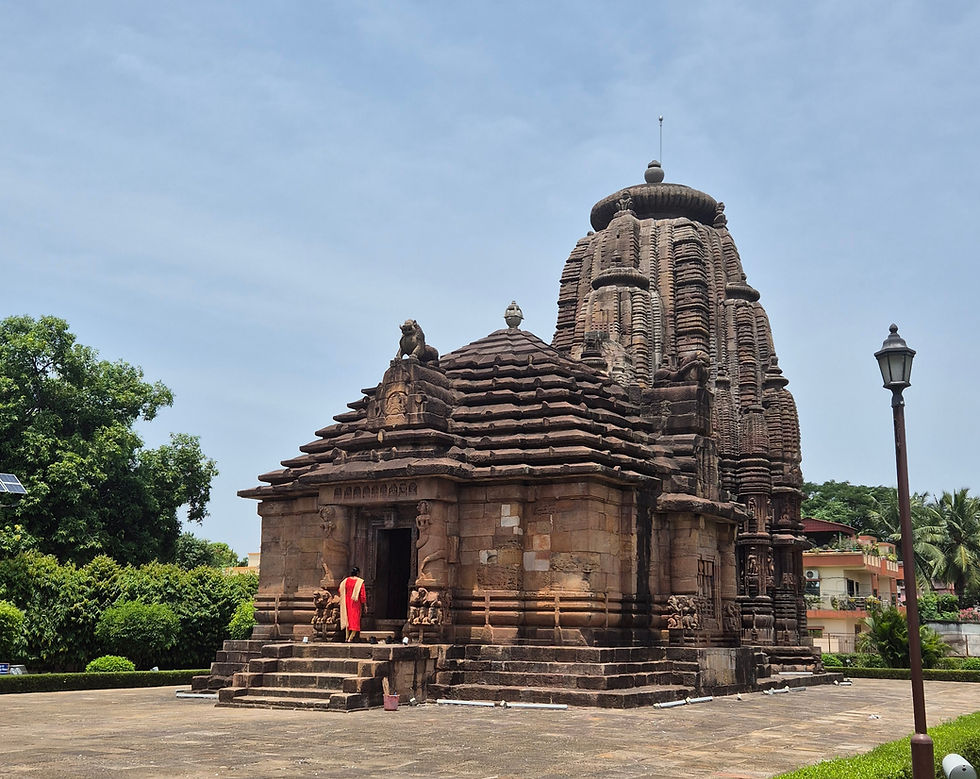
The Vaital temple is of the many intriguing temples in Bhubaneshwar. To begin with, the structure itself resembles a South-Indian temple more than the typical Kalingan style that we see everywhere else in Odisha. The temple has been dated to the last quarter of the 8th century CE.

Further, unlike most of the temples in Bhubaneshwar, this temple is not dedicated to Lord Shiva. Inside the sanctum is one of the deities who is very rarely seen in a sanctum – Chamunda, along with the Saptamatrikas. This is evidently a Shakta shrine. However, the presence of Lakulisha on the vimana indicates the connection with the Pasupata sect, which is most prevalent in this region during this time period. Further, the name of the temple – ‘Vaital’, comes from the word ‘vetala’, referring to spirits, which were invoked by tantrics to attain siddhis. Thus, this temple is an amalgamation of Pasupata and Shakta philosophy, with a strong emphasis on tantric rituals, and this is reflected in the iconography of the sculptures seen here. Just to clarify – I am sharing only photos of the exterior of the temple in this post, since the temple was closed during both my visits. I have read of some very interesting free-standing sculptures inside, including the Saptamatrikas and Bhairavas, but since I have yet to see them, I am not going to be talking about them. So, let us see what we can learn about this temple just from what we can see on the outside.
Let us start with the vimana, the spire of the temple. As I have already mentioned, it reminds me of the south-Indian style of temple architecture. While there are specific terms architecturally for this kind of structure, without getting into technical details, it is enough to understand that this temple tells us about a period where temple architecture was still fluid (in a sense), or, to put it another way, when people were still experimenting with different styles.

My eyes were first drawn to this gorgeous Natesa, right at the top. He is Natesa and not Nataraja because he does not yet have the demon or apasmara purusha below him. He has 12 arms, carrying a variety of attributes including a trishul, snake, cup and rosary. Two of his arms are in a dancing posture. One arm lovingly caresses Parvati on his left. Very interestingly, he is shown with an erect phallus, like at the Parasurameshwara temple.

The next eye-catching sculpture is right below Natesa – Surya. This is an east-facing temple, and the placement of Surya here is interesting. It could be meant to simply indicate the direction, and acknowledge the presence of the Sun in that direction. However, it could well have a deeper meaning, such as an indication of the presence of the cult of Surya in the region. (Though Konark is not too far, that temple is much later). This is an especially gorgeous Surya, showing him riding on his chariot drawn by seven horses, his charioteer Aruna handling the reins. He holds two fully bloomed lotuses in his two arms. He has a halo around his head, and he also appears to wear some kind of armour. Above him are two divine creatures holding garlands, and on his two sides are Usha and Sandhya, the goddesses of dawn and dusk, with their bows and arrows. The only attribute of Surya not visible in this sculpture are his boots.

On the central niche of the southern wall is Parvati, with 4 arms and two attendants by her side.

Above her is Uma Maheshwara, with Parvati familiarly putting her hand on Shiva’s shoulder. Once again, Shiva is shown with an erect phallus, and in his right ear is an ear-ring with a snake peeping out, just like at the Parasurameshwara temple.

Further above, on a gavaksha is Lakulisha, shown once again with an erect phallus, holding a club, and surrounded by 4 of his disciples. I especially love how he is shown with curls, and the detail of the ear-ring, on the upper lobe of his ear.
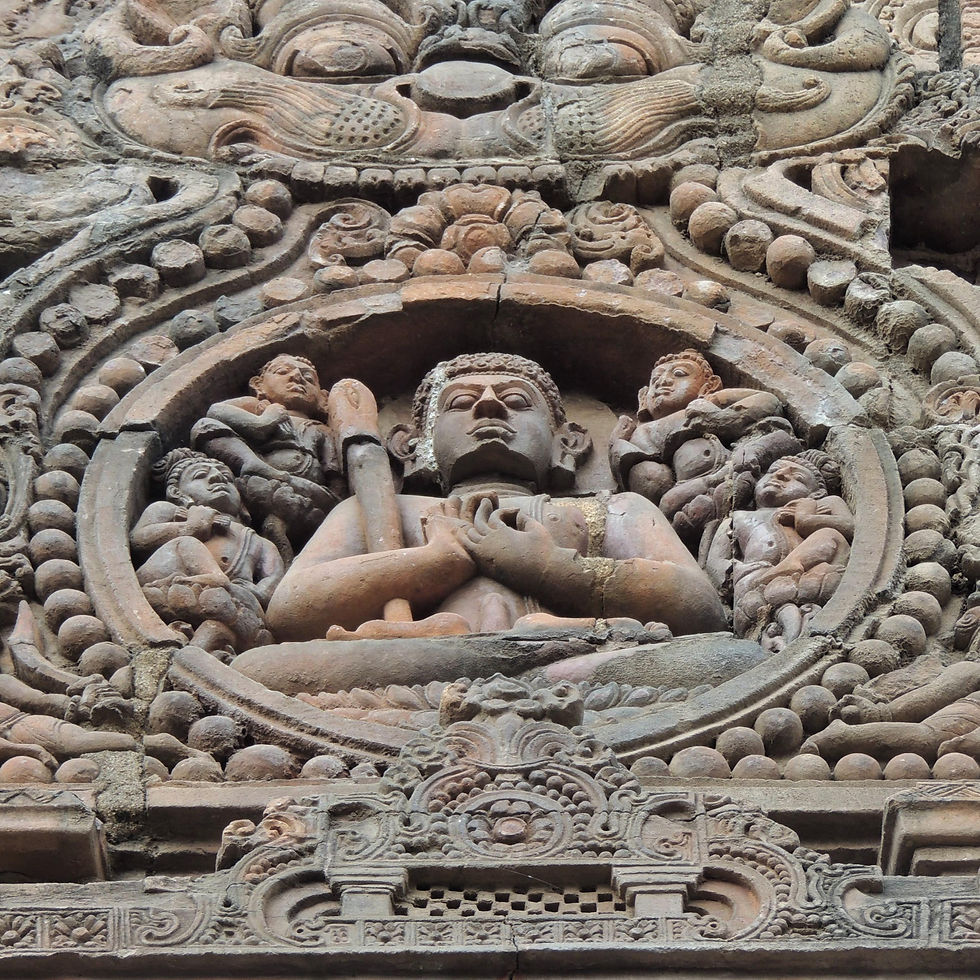
In the central niche on the western side of the temple is Ardhanareeshwara. The right-hand side depicts Shiva, with his jata, holding a rosary (akshamala), with Nandi the bull behind him. The left side, representing Parvati is more delicate, see the curve of her waist… She wears jewelry, and we can see her jeweled waist-band, which resembles the one worn by Odissi dancers even today. It is not clear what she holds in her hand, but it might have been a mirror.

Other niches on this wall have images of women – Nayikas, in a variety of postures. One is shown holding a mirror and adorning herself, another stands holding a branch of a tree, Yet another Nayika stands holding what appears to be a flower, leaning against what may be a pillar, or something stacked… While the fourth adjusts her clothing as someone below her watches.


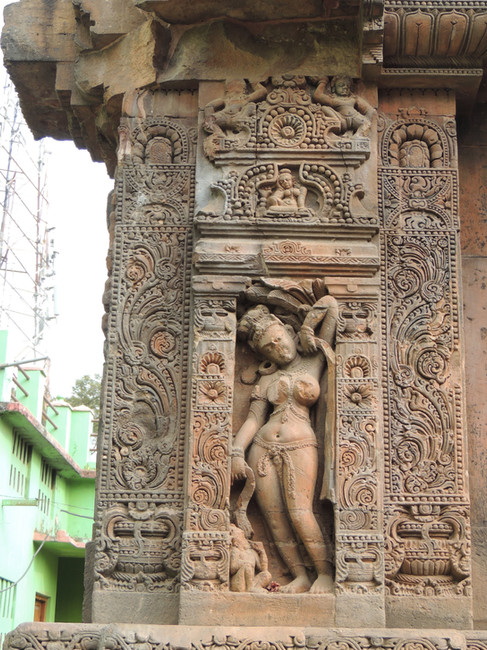
Along this entire wall, please note that the gavakshas above the Nayikas all depict different things…. A lion, a wheel, a woman, Shiva’s face…. There is no clear system here yet… the artisans appear to be experimenting with sculptures as well. Also note the row of detailed sculptures further above on the vimana.

The northern wall main niche has this stunning Mahishasuramardini. The demon Mahisha is shown as a buffalo, and she is shown grappling with him, pushing her trident into his heart, even as her lion attacks him from the other side. She holds a variety of weapons other than the trident in her 12 hands – a sword, a shield, a double-sided dagger, and also a snake. This has to be one of the most beautiful Mahishasuramardinis I have ever seen, a very dynamic sculpture. The single hibiscus flower placed by a devotee only adds to her beauty.

On both sides of Mahishasuramardini are mithuna couples, with the lions and riders above them.


Every inch of this temple has been carved with a love for detail. There are a variety of figures, such as these couples interspersed among lone figures…

Among them is suddenly this image of Bhikshatanamurthy – a form of Shiva as mendicant. He is seen here with a sage on his right, and one of the sages’ wives on his left, offering him alms.

These figures continue all around the vimana, right up to the top. They depict various figures, including hunting scenes.







So, what do all these sculptures tell us about this temple?
The presence of Chamunda along with the Saptamatrikas inside the shrine clearly marks it as a Shakta shrine. This is emphasized by the preponderance of female deities seen on the outer walls – Parvati and Mahishasuramardini especially. Then, we have images of Shiva as well as Ardhanareeshwara and Uma Maheshwara, so while the shrine may be Shakta, the affinity is to Shaivism. The presence of Lakulisha marks this affinity to the Pasupata sect specifically. The presence of Surya indicates a connection, however slight to the Saura sect, sun worshippers.
This is why I am so intrigued by this temple. Someday, hopefully, I will be able to enter this temple as well, and go see the sculptures inside, and learn a little more about it.
Other posts on Odisha -


Comments