The Hindu and Buddhist history of Odisha , or rather, ancient Kalinga, is rather well known to everyone. Who hasn’t heard of the grand temples of Odisha – Puri, Lingaraj and Konark, or the great war of Kalinga which inspired Ashoka to convert to Buddhism? In contrast, very few know of the Jaina heritage of this region. This is quite a pity, since, just around 7 km from the city, is one of India’s most ancient inscriptions, which throws light on the Jaina heritage of Odisha. This inscription is the Hathigumpha inscription of Kharavela, in the hills of Udaygiri. Udaygiri and Khandgiri are two hills located opposite each other, and both are testaments to the rich Jaina heritage of Odisha. The caves at Udaygiri are older, while Khandgiri is relatively newer, but has lasted much longer, and continues to be a place of pilgrimage for Jains even today. These hills, from inscriptions and excavations of caves, shrines and rock beds, appear to have been a haven for Jaina monks, right from the ...
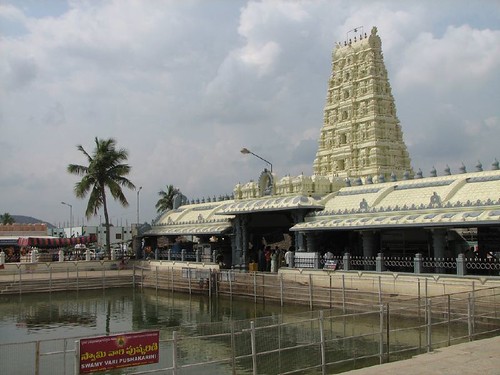
The temple of Varasiddhi Vinayaka at Kanipakkam is one I have seen grow over the last few years I have been there. When I visited the temple this time, I found myself wishing that I had taken photos of the temple on my earlier visits (which, incidentally were before I began blogging!), for this time I was advised to leave the camera in the vehicle itself!
 |
| Image from the internet |
The legend of the temple relates to three brothers, of whom, one was deaf, one was dumb and one was blind. They tilled their land together and made a living. When their well dried up, they dug another well, but were stumped when they were unable to dig further than a particular level. When they tried harder, the iron spade hit a stone which began to ooze out blood! The minute the blood oozed out, the brothers lost their deformities, and were stunned to see the sight! The villagers were amazed, and attempted to deepen the well further to see the origin of the blood. Finally, from the waters emerged an idol of Lord Ganesha, who is named ‘Varasiddhi Vinayaka’ because he makes wishes come true.
 |
| Image from the Internet |
For many years, only a portion of the idol was visible, and all attempts to dig further were useless. However, over the years, more and more of the idol is being seen, something which is proved by the fact that the original kavacham (mask) for the idol no longer fits it! Some portion of the idol is still in the well, though, and water can be seen in the main sanctum even now!
When I first visited the temple, we were among the few pilgrims there, and the priest happily showed us the water swirling around the idol. The old kavacham was displayed outside the sanctum and it was quite apparent that the idol had grown. On this trip (almost 5 to 6 years after my first visit), there were a lot more changes – the temple was much bigger than I remembered it to be; the queues were much, much longer, there was a special darshan ticket for Rs.100; there were not one, but two smaller kavachams outside, now displayed proudly in a glass case; and there was much less water in the sanctum, which was rather surprising considering that it was pouring heavily outside and the whole temple was wet and slippery! So much for popularity and improvement!!!!
While I cannot help saying that I wish the temple had not changed so much, I do realize that changes are inevitable, especially as more and more people become aware of the place. But I shall always remember it as the temple I saw it first – unknown but remarkable!!
Information:
Kanipakkam is 75 Km from Tirupati and 165 Km from Chennai.
APSRTC runs daily buses between Tirupati and Kanipakkam.
Kanipakkam Temple Website: http://www.kanipakamvinayaka.org/
The temple website is comprehensive, with lots of details about the temple, as well as information about accommodation and seva activities.
Temple Timings: 04:00 AM to 9:30 PM

Iinteresting.....about the idol of Ganesha.
ReplyDeleteVery beautiful temple... Yes the security keeps on increasing day by day...
ReplyDeletethnaks for introducing this place .........
ReplyDelete@Haddock: Oh yes... the idol is what interested me first about the place...
ReplyDelete@Arti: thats the problem everywhere... cant recognise half the places thanks to all the new security arrangements
@Team G square: hope u can visit sometime...