The Hindu and Buddhist history of Odisha , or rather, ancient Kalinga, is rather well known to everyone. Who hasn’t heard of the grand temples of Odisha – Puri, Lingaraj and Konark, or the great war of Kalinga which inspired Ashoka to convert to Buddhism? In contrast, very few know of the Jaina heritage of this region. This is quite a pity, since, just around 7 km from the city, is one of India’s most ancient inscriptions, which throws light on the Jaina heritage of Odisha. This inscription is the Hathigumpha inscription of Kharavela, in the hills of Udaygiri. Udaygiri and Khandgiri are two hills located opposite each other, and both are testaments to the rich Jaina heritage of Odisha. The caves at Udaygiri are older, while Khandgiri is relatively newer, but has lasted much longer, and continues to be a place of pilgrimage for Jains even today. These hills, from inscriptions and excavations of caves, shrines and rock beds, appear to have been a haven for Jaina monks, right from the ...
Ayodhya, the birthplace of Rama is bout 250 Kms from Varanasi. The river Sarayu flowing through this holy city is reason enough for a visit there. We expected the river to be dry, as it was the peak summer, but the quantity, the force and the depth of the water surprised us. Again, if time hadn’t been a factor, we wouldn’t have come out of the water at all. In fact, one of the best things that happened on this trip is that my son Samhith has lost his fear of water. 10 days of bathing in rivers has not only made him overcome his fear, but now he enjoys having a dip in rivers, and is proud of his ‘dubki’ or a full dip in the river, and actually tries to hold his breath under water!
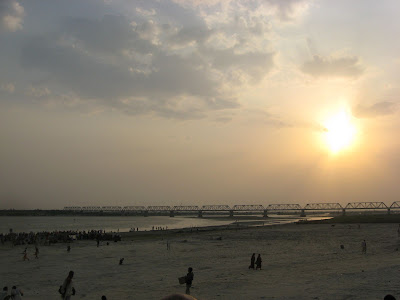
The Sun Rises over the Sarayu River
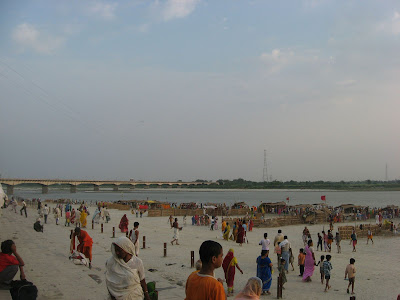
The Crowds throng the river into which Rama merged at the end of his rule on earth.
Ayodhya is much worse than Varanasi when it comes to extortion from pilgrims in the name of religion. In fact, even though we were accompanied by a guide, the number of people who tried to get money out of us in the name of Hinduism spoilt the entire trip for us. We made the trip to the Ram Janmabhoomi, which has been in the news for all the wrong reasons. When we had got through all the tight security, and walked the long distance to what was supposedly the exact place where Rama was born, I found myself thinking, not about God, but whether all that bloodshed was really worth it. I have never been a supporter of what some call ‘doing good in the name of Hindutva’, and a visit to this place which has seen the governance of a king like Rama as well as destruction in His name, made me sad , to say the least.
The Hanuman Gadhi, a temple of Hanuman is the only one which shows Hanuman on a throne. It is believed that Rama asked him to rule the city when there was no ruler.
While at Ayodhya, try to stay at the Birla Dharamshala. It is an amazingly clean and nice place, and if you can get one the few AC rooms, there’s nothing like it. 5 to 6 people can easily stay in one room and the experience will be like that at a 5 star hotel!
Places to Visit around Ayodhya
The Sun Rises over the Sarayu River
The Crowds throng the river into which Rama merged at the end of his rule on earth.
Ayodhya is much worse than Varanasi when it comes to extortion from pilgrims in the name of religion. In fact, even though we were accompanied by a guide, the number of people who tried to get money out of us in the name of Hinduism spoilt the entire trip for us. We made the trip to the Ram Janmabhoomi, which has been in the news for all the wrong reasons. When we had got through all the tight security, and walked the long distance to what was supposedly the exact place where Rama was born, I found myself thinking, not about God, but whether all that bloodshed was really worth it. I have never been a supporter of what some call ‘doing good in the name of Hindutva’, and a visit to this place which has seen the governance of a king like Rama as well as destruction in His name, made me sad , to say the least.
The Hanuman Gadhi, a temple of Hanuman is the only one which shows Hanuman on a throne. It is believed that Rama asked him to rule the city when there was no ruler.
While at Ayodhya, try to stay at the Birla Dharamshala. It is an amazingly clean and nice place, and if you can get one the few AC rooms, there’s nothing like it. 5 to 6 people can easily stay in one room and the experience will be like that at a 5 star hotel!
Places to Visit around Ayodhya
Chitrakoot (270Kms from Varanasi and about 150Kms from Ayodhya)– the place where Rama, Lakshmana and Sita first lived during their exile. There are a number of places of tourist and religious interest here. Not surprising, considering that Rama lived here for a number of years. Among the famous places are
- Kamad Giri- where the mountain is believed to represent Vishnu himself
- Hanumat Dhara- where a river emerges from the gada or mace of Hanuman’s idol
- Spatik Shila- on the banks of the Mandakini, from where Rama aimed an arrow to hit a crow (who was actually Jayanta, the son of Indra) which was troubling Sita.
- Gupta Godavari- from where the river spring up on being hit by Rama’s arrow.
- Naimisharanya (400Kms from Varanasi and about 250 Kms from Ayodhya)- this is the sacred place where the Vedas, Puranas and Shastras were supposedly written, , and where sage Veda Vyasa recited the Vedas for the benefit of the Devas under a 5000 year old Banyan tree. The Gomati River flows here, the banks of which are covered by religious institutions from every part of India
Comments
Post a Comment
Thanks so much for stopping by. Please leave a comment for me so that I will know you have been here....