The Hindu and Buddhist history of Odisha , or rather, ancient Kalinga, is rather well known to everyone. Who hasn’t heard of the grand temples of Odisha – Puri, Lingaraj and Konark, or the great war of Kalinga which inspired Ashoka to convert to Buddhism? In contrast, very few know of the Jaina heritage of this region. This is quite a pity, since, just around 7 km from the city, is one of India’s most ancient inscriptions, which throws light on the Jaina heritage of Odisha. This inscription is the Hathigumpha inscription of Kharavela, in the hills of Udaygiri. Udaygiri and Khandgiri are two hills located opposite each other, and both are testaments to the rich Jaina heritage of Odisha. The caves at Udaygiri are older, while Khandgiri is relatively newer, but has lasted much longer, and continues to be a place of pilgrimage for Jains even today. These hills, from inscriptions and excavations of caves, shrines and rock beds, appear to have been a haven for Jaina monks, right from the ...
The temple resounds with bhajans, sung of Meera and Krishna.
Devotees enter, and settle down in any available space, and join in the
singing, enthusiastically. It’s evident that everyone knows the words. There
are no queues, but there is a sense of order. No one is in a hurry. They wait
patiently for others to have darshan
before getting up for a closer look at the Lord. The temple is small, but
beautiful, with intricate paintings on the ceiling. There is no space to stand
and admire, so I sit down, along with everyone else, and allow my eyes to
wander over the ceiling, rather than the image in the sanctum.
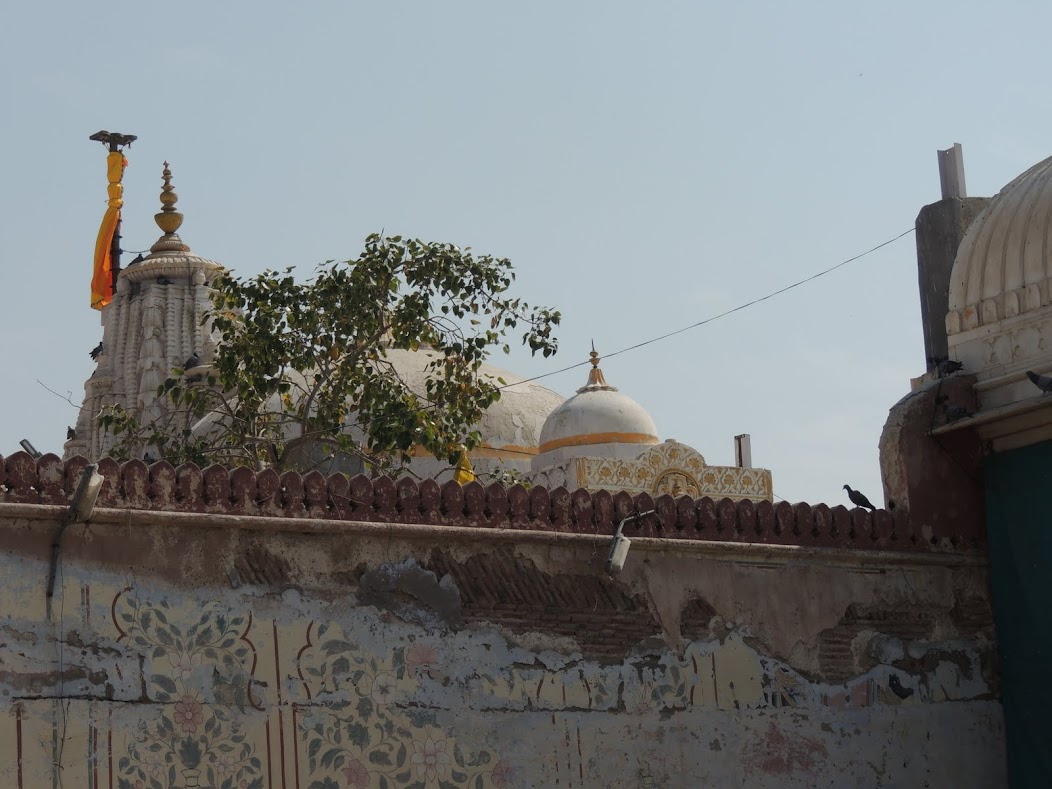
The Laxmi Nath Temple was built in 1504, during the reign of
Rao Luna Karan, the 3rd king of Bikaner. There might have been older
shrines around, or even right here, but this was one of the first Hindu temples
built here. It is dedicated to Vishnu, seen here as Laxmi Nath, along with his
consort, Laxmi, the goddess of wealth, suggesting that, during that period, the
early 16th century, there was a strong Vaishnavite presence in
Bikaner. This is believed to have been one of the earliest temples built by the
royal family, and the Lord is believed to have been their patron deity, under
whose influence they ruled this land.
The main shrine is a small one, as I have mentioned, and the
paintings on the ceiling are embellished with gold, a technique we see at the
Junagadh Fort as well. Around the central temple are other smaller shrines,
dedicated to the many Gods of the Hindu pantheon. The entire complex is a
walled one, and photography is prohibited.
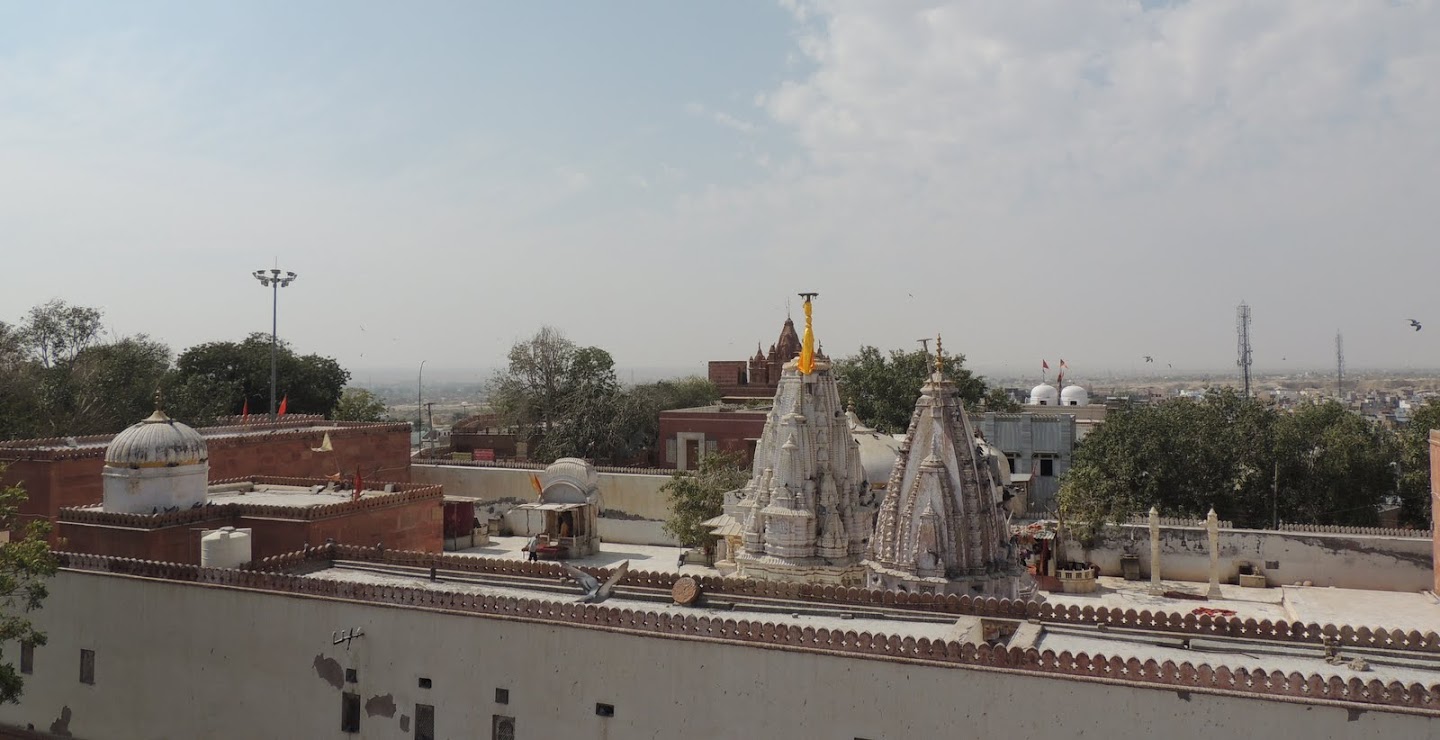 |
| The Laxmi Nath Temple Complex, as seen from the Jain temple |
The Laxmi Nath temple is located right next to the Jain temple,
and both temples would have been constructed around the same time. While the
Jain temple, being more elaborate, took over 40 years to build, and was
completed in 1514, the Laxmi Nath temple took 22 years to complete, and was
ready by 1526.
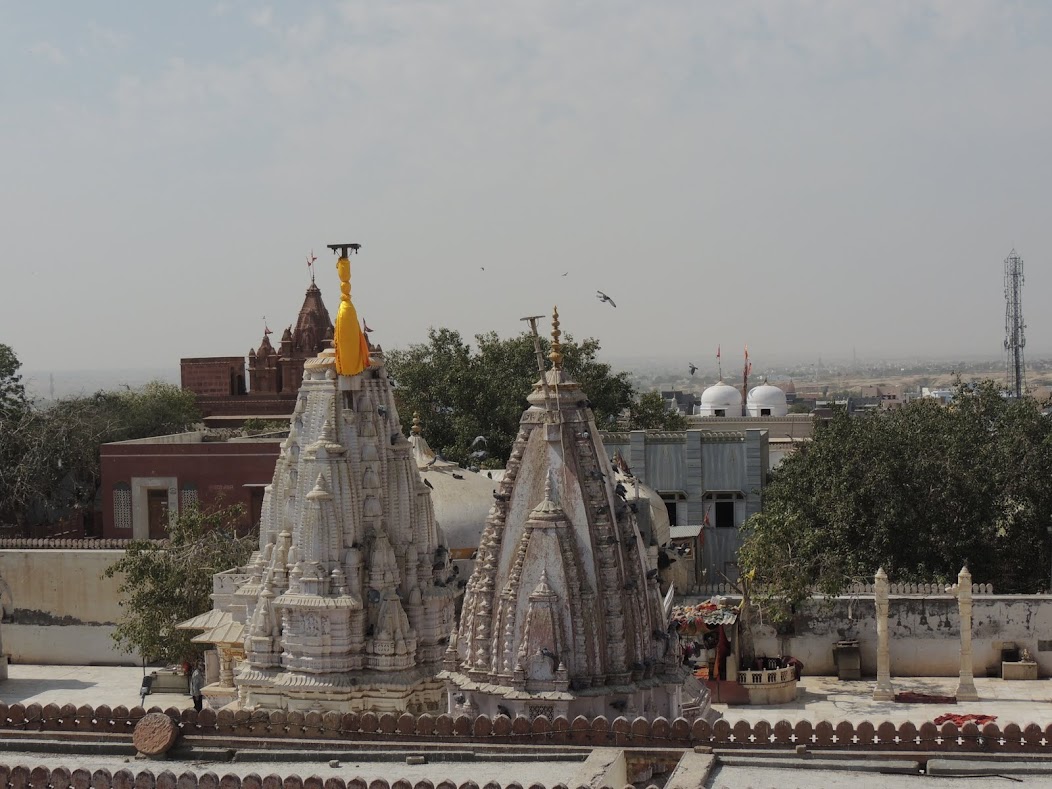 |
| The spires of the Laxmi Nath Temple, as seen from the Jain temple |
A comparison of the two temples leads to some interesting
thoughts. Built roughly around the same time, the architecture, as well as the
ornamentation of the Jain temple is far more elaborate. While the Laxmi Nath
temple is considered to be the temple of the royalty, does it also hint that
the merchants even then had far more wealth available, even for construction of
temples, than royalty?
And yet, it is the Laxmi Nath Temple which is a hub of
activity, with locals visiting and offering prayers. While the Jain temple is
also under worship, the visitors are more tourists than locals, since many of
the wealthy Jain merchants have shifted to other cities and only visit
occasionally.
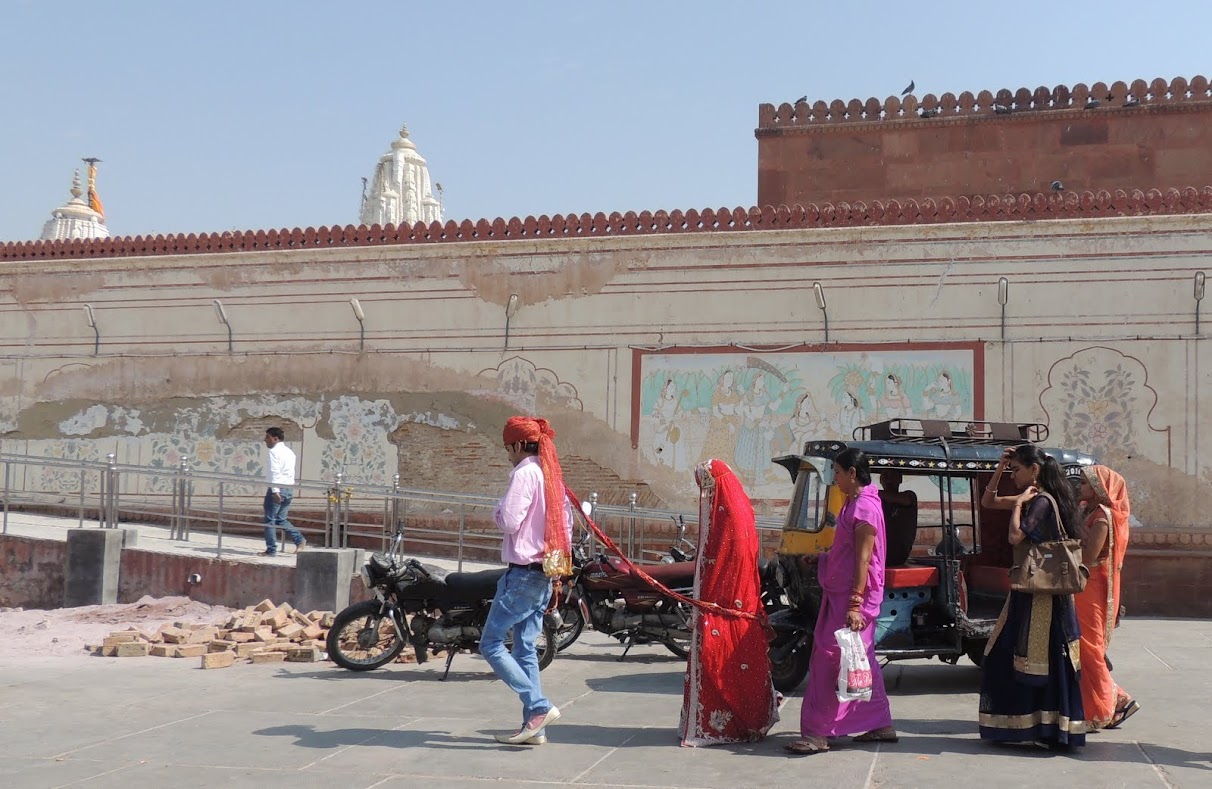 |
| A newly married couple visit the temple, immediately after their wedding. This, apparently, is a common custom in the area. |
Disclaimer: These posts are based on two trips to Bikaner – the first one, a personal trip, and the second, when I was invited by Narendra Bhawan. While the first was an enjoyable experience with my family, I barely spent a day here, and while it was enough to see the sights, it was too quick to leave an impression.
The second trip, which was on invitation from Narendra Bhawan, filled the gaps and added a context to all that I had seen before, which actually helped me write. While the experiences are courtesy Narendra Bhawan, the words are, needless to say, all my own!
Related Posts:
- Temples of Bikaner - Part 1: The Karni Mata Temple
- Temples of Bikaner - Part 2: The Bhanda Shaha or Bhandasar Jain Temple

Comments
Post a Comment
Thanks so much for stopping by. Please leave a comment for me so that I will know you have been here....