The Hindu and Buddhist history of Odisha , or rather, ancient Kalinga, is rather well known to everyone. Who hasn’t heard of the grand temples of Odisha – Puri, Lingaraj and Konark, or the great war of Kalinga which inspired Ashoka to convert to Buddhism? In contrast, very few know of the Jaina heritage of this region. This is quite a pity, since, just around 7 km from the city, is one of India’s most ancient inscriptions, which throws light on the Jaina heritage of Odisha. This inscription is the Hathigumpha inscription of Kharavela, in the hills of Udaygiri. Udaygiri and Khandgiri are two hills located opposite each other, and both are testaments to the rich Jaina heritage of Odisha. The caves at Udaygiri are older, while Khandgiri is relatively newer, but has lasted much longer, and continues to be a place of pilgrimage for Jains even today. These hills, from inscriptions and excavations of caves, shrines and rock beds, appear to have been a haven for Jaina monks, right from the ...
The first three days of Navaratri are dedicated to the goddess Parvati, and yesterday was the last of this phase. When I told my son about this, he decided that since he could not dress up as Parvati obviously, he would dress up as Shiva, his main interest was in being allowed to hold a Trishul. Of course we refused, so he compromised by agreeing to wear a ‘Veshti’ and making a Trishul with his blocks. We hosted the Navaratri Bhajan at our place yesterday, and this gave him an added reason to dress up. “If you all can wear lovely sarees and dress up, why can’t I dress up too?” was his legitimate question. You can see the results in the photographs below.
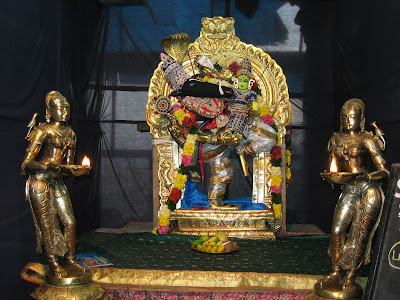
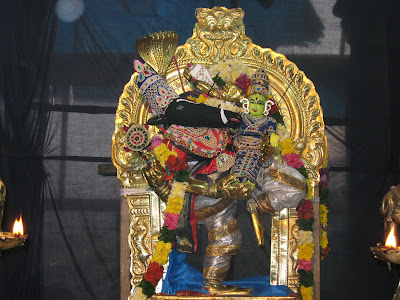
At the temple, the decoration was dedicated to BHUVARAHA SWAMY – this is the form of Vishnu when he too the form of a wild boar – the Varaha Avatar. The lord took this form when the demon Hiranyaksha hid Bhoomi Devi (Mother Earth) in the ocean. In the form of a wild boar, the lord Carried Bhoomi Devi out of the water and placed her carefully in her place before going back to kill the demon. Here, He is depicted as carrying Bhoomi Devi in his arms. This form of Vishnu is seen at Tirupati, where He is believed to have given the land to Lord Venkateswara, allowing Him to reside there. It is customary to have darshan of Varaha swamy before having darshan of Lord Venkateswara.
People who want to buy a house or land pray to BhuVaraha Swamy or participate in the Bhu Varaha Yagna. In Tamilnadu, there is a famous temple of Bhuvaraha swamy at Srimushnam near Chidambaram. In Karnataka, there is a gigantic 21 feet high image of Pralaya Varaha Moorthy with a 6 feet tall Lakshmi sitting on his lap, at Kalahalli in Krishnarajpet Taluk in Mandya District.
That’s all for today folks. Hope to get back to all of you tomorrow with lots more photographs.
 |
| From Miscellaneous |
 |
| From Miscellaneous |
At the temple, the decoration was dedicated to BHUVARAHA SWAMY – this is the form of Vishnu when he too the form of a wild boar – the Varaha Avatar. The lord took this form when the demon Hiranyaksha hid Bhoomi Devi (Mother Earth) in the ocean. In the form of a wild boar, the lord Carried Bhoomi Devi out of the water and placed her carefully in her place before going back to kill the demon. Here, He is depicted as carrying Bhoomi Devi in his arms. This form of Vishnu is seen at Tirupati, where He is believed to have given the land to Lord Venkateswara, allowing Him to reside there. It is customary to have darshan of Varaha swamy before having darshan of Lord Venkateswara.
 |
| From Miscellaneous |
People who want to buy a house or land pray to BhuVaraha Swamy or participate in the Bhu Varaha Yagna. In Tamilnadu, there is a famous temple of Bhuvaraha swamy at Srimushnam near Chidambaram. In Karnataka, there is a gigantic 21 feet high image of Pralaya Varaha Moorthy with a 6 feet tall Lakshmi sitting on his lap, at Kalahalli in Krishnarajpet Taluk in Mandya District.
 |
| From Miscellaneous |
That’s all for today folks. Hope to get back to all of you tomorrow with lots more photographs.
Comments
Post a Comment
Thanks so much for stopping by. Please leave a comment for me so that I will know you have been here....