The Hindu and Buddhist history of Odisha , or rather, ancient Kalinga, is rather well known to everyone. Who hasn’t heard of the grand temples of Odisha – Puri, Lingaraj and Konark, or the great war of Kalinga which inspired Ashoka to convert to Buddhism? In contrast, very few know of the Jaina heritage of this region. This is quite a pity, since, just around 7 km from the city, is one of India’s most ancient inscriptions, which throws light on the Jaina heritage of Odisha. This inscription is the Hathigumpha inscription of Kharavela, in the hills of Udaygiri. Udaygiri and Khandgiri are two hills located opposite each other, and both are testaments to the rich Jaina heritage of Odisha. The caves at Udaygiri are older, while Khandgiri is relatively newer, but has lasted much longer, and continues to be a place of pilgrimage for Jains even today. These hills, from inscriptions and excavations of caves, shrines and rock beds, appear to have been a haven for Jaina monks, right from the ...
Fridays are always auspicious for the Devi, and Fridays during Navaratri are even more special. Normally, when we perform the puja at home, we invite everyone home for Haldi – Kumkum on a Friday, but this year, we were busy visiting others, as we did not have the puja ourselves.
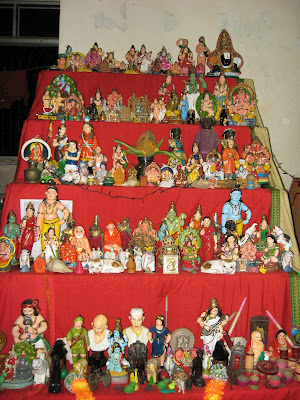
Here is a photograph of the kolu at one of our neighbours’. Samhith went to see it first and told them that they had very few toys, as compared to his grandmother. He also gave them suggestions about what they could do to make it look even better. Of course, his interest in the golu is great, but I don’t know what I am going to do if the chap keeps talking like this!
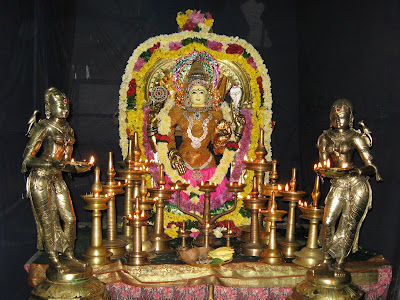
The decoration in the temple was of CHOTTANIKKARA BHAGAVATHI. The Devi looked beautiful amidst a number of oil lamps, which had been lit to give a wonderful effect.
The Chottanikkara Bhagavathi temple is one of the most important and famous temples of Kerala, and needs no introduction. The Devi here is prayed to as Saraswati in the morning, as Lakshmi at Noon, and as Parvati in the evening. It is believed that goddess Saraswati as Mookambika resides here early in the morning, and hence the first prayer is to Saraswati. Moreover, it is said that the temple to Mookambika at Kollur in Karnataka opens only later in the morning after the prayers here are completed, and she returns to her abode at Kollur.
Well, today, Saturday is going to be a busy day, as I have to visit more people. I hope I shall be able to get more material to write about, especially more photographs…. Until then, Goodbye!!!!
Here is a photograph of the kolu at one of our neighbours’. Samhith went to see it first and told them that they had very few toys, as compared to his grandmother. He also gave them suggestions about what they could do to make it look even better. Of course, his interest in the golu is great, but I don’t know what I am going to do if the chap keeps talking like this!
 |
| From Miscellaneous |
The decoration in the temple was of CHOTTANIKKARA BHAGAVATHI. The Devi looked beautiful amidst a number of oil lamps, which had been lit to give a wonderful effect.
 |
| From Miscellaneous |
The Chottanikkara Bhagavathi temple is one of the most important and famous temples of Kerala, and needs no introduction. The Devi here is prayed to as Saraswati in the morning, as Lakshmi at Noon, and as Parvati in the evening. It is believed that goddess Saraswati as Mookambika resides here early in the morning, and hence the first prayer is to Saraswati. Moreover, it is said that the temple to Mookambika at Kollur in Karnataka opens only later in the morning after the prayers here are completed, and she returns to her abode at Kollur.
 |
| From Miscellaneous |
Well, today, Saturday is going to be a busy day, as I have to visit more people. I hope I shall be able to get more material to write about, especially more photographs…. Until then, Goodbye!!!!
Comments
Post a Comment
Thanks so much for stopping by. Please leave a comment for me so that I will know you have been here....