The Hindu and Buddhist history of Odisha , or rather, ancient Kalinga, is rather well known to everyone. Who hasn’t heard of the grand temples of Odisha – Puri, Lingaraj and Konark, or the great war of Kalinga which inspired Ashoka to convert to Buddhism? In contrast, very few know of the Jaina heritage of this region. This is quite a pity, since, just around 7 km from the city, is one of India’s most ancient inscriptions, which throws light on the Jaina heritage of Odisha. This inscription is the Hathigumpha inscription of Kharavela, in the hills of Udaygiri. Udaygiri and Khandgiri are two hills located opposite each other, and both are testaments to the rich Jaina heritage of Odisha. The caves at Udaygiri are older, while Khandgiri is relatively newer, but has lasted much longer, and continues to be a place of pilgrimage for Jains even today. These hills, from inscriptions and excavations of caves, shrines and rock beds, appear to have been a haven for Jaina monks, right from the ...
In my earlier post, I wrote about the flamingos we saw at Sewri. They are, after all, the main reason people flock to Sewri these days at low tide! However, there are also scores of other birds which arrive at Sewri for the insects which populate the mud flats. This post is about some of them...

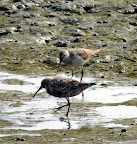
On an earlier visit to Sewri, I remember seeing a large number of small and medium sized birds - little stints, sandpipers, varieties of herons and egrets..... and being told that all these birds migrate to the same areas and live off the same place, without any conflict of interest, since each of them has a different kind of bill or beak, made for eating different varieties of insects or creatures, found in different layers of the soil. Some have small bills which barely skim the surface of the mudflats, eating the creatures inhabiting the upper layer...while others have much longer beaks, which penetrate deeper into the soil, convenient for entrapping insects hidden deep within. It was amazing to learn how these birds manage to live in harmony.


These are either Little Stints or Sandpipers. My identification skills dont extend so far as to make a perfect ID! So, can all you birders out there please confirm the identity of this bird?


I first thought these were two different species of birds, but apparently, they are the same species,, just the ones in front are in breeding plumage!


There were other birds too.... A painted stork was spotted at a distance, but it flew before I could click a pic. This Black Headed Ibis turned up rather late in the day, just as I was about to leave....


Waiting a while longer turned out to be a good thing, for we next spotted a Western Reef Egret..


There were other, common birds too... such as this Egret...

and this Pond Heron, which I see in my colony, but have never managed to capture this well!!

Oh, and these werent the only creatures we saw at Sewri.. just the birds!! There are a couple more posts coming up!
Related Posts

Very pretty pictures!
ReplyDeleteInteresting, visual post!
ReplyDeleteI like the comprehensive range of bird species that you have managed to photograph. Well done.
ReplyDeleteMy bird watching is confined at home but they are the traditional ones only seen during a particular season. In this post I find many many more beautifully captured.
ReplyDeleteLovely captures. Such variety too. They all look graceful doing their business for the day!
ReplyDeleteenjoyed looking at them. Thanks.
Wow...the pictures are breathtaking Anu! It seems to be a great place for bird watching!
ReplyDeleteNice collection of birds
ReplyDeletethanks for sharing
Brilliant stuff!
ReplyDeleteGurgaonflowerplaza.com
superb shots of birds
ReplyDeleteThe bird in the first and fourth photos is a common sandpiper, notice the short straight beak. The birds in a few subsequent photos are apparently curlew sandpipers, some in breeding plumage, notice the slightly down-turning longer beaks. Nice shots.
ReplyDelete