
Featured Post

Temples of Kashi - The Tilbhandeshwar Temple

The city of Kashi is filled with temples, big and small, old and new. There are temples at every corner, and you never know where you will stumble upon a small shrine. There are idols beneath what remains of trees (there are hardly any trees any more within the core area of the city), there are saffron covered forms resembling deities which seem attached to walls, an especially incongruous sight when the idol itself appears to be old, while the wall is evidently new…. And there are surprisingly large temples rising from what appear to be a bunch of houses. The city is sometimes colloquially said to be as old as time, and some of the shrines and temples are said to date back to times unknown, at least the deity itself, if not the structure. Not much remains of the ancient structures anyway. The city has seen more than its fair share of good and bad times. It has seen the heights of grandeur, and the lows brought about by destruction. The city that exists today has grown so haphaza...

Khajuraho - The Unexpected

Khajuraho. The very name conjures up exotic images of erotic art on temple walls. However, there is so much more to Khajuraho than just the erotic, or even just temples. Last December, Samhith and I spent three days at Khajuraho, exploring as much of the ancient town as we could, and over the next few weeks, I shall try to show you the Khajuraho that we saw, beginning with this photo clicked at the Kandariya Mahadev Temple.
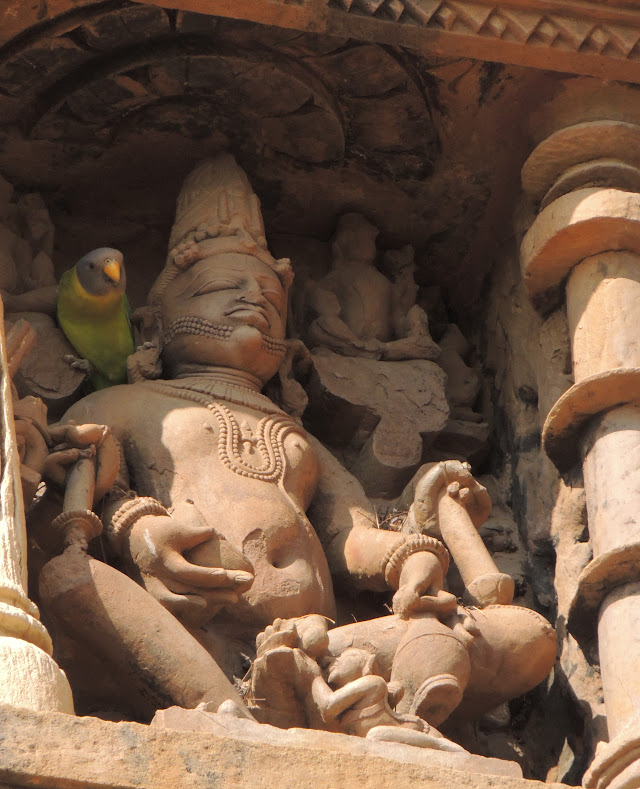


The Kandariya Mahadev is one of the most impressive temples at Khajuraho, and it’s the details which make it so impressive. This particular figure is of Agni, the God of Fire. Here, though, he is one of the Ashta-Dikpalas, the guardians of the 8 directions. Agni guards the South-East, and it’s his placement on the South East wall of the temple, which allows us to identify him here. Notice the finer details, such as his beard….
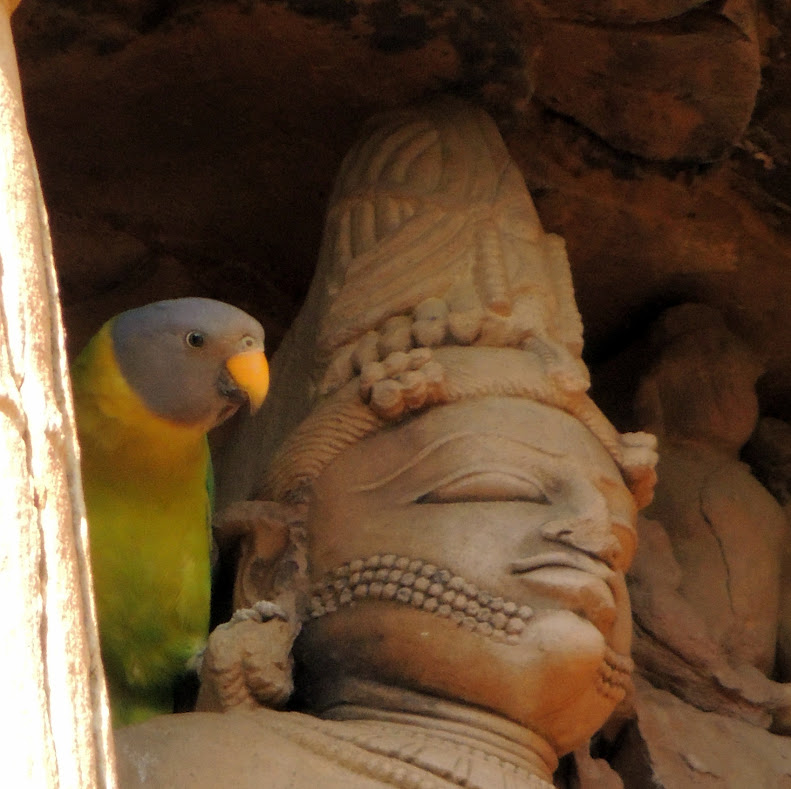


These photos are among my favourites; among the hundreds I clicked at Khajuraho, thanks to this female Plum-Headed Parakeet which chose Agni to be her perch!

Her mate was nearby, perched on one of the smaller Shikaras….
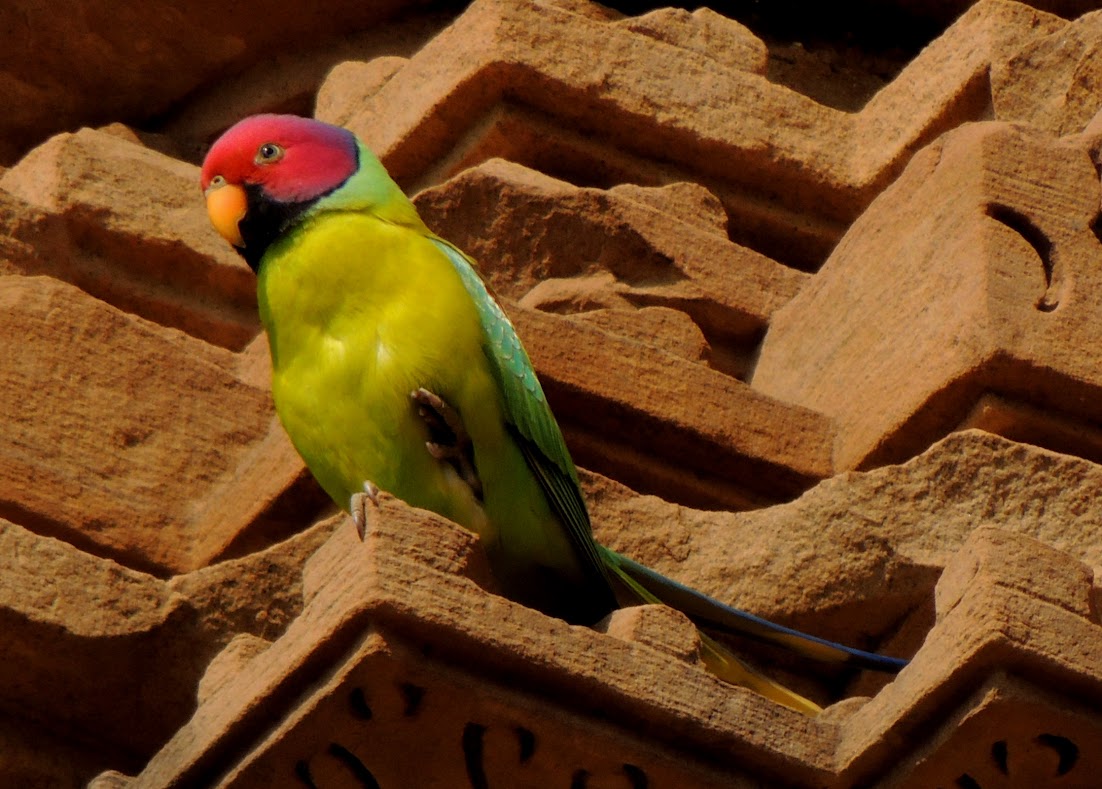


And they patiently posed for me as I went click-happy; thrilled by the sight of birds on a temple, a combination I am always thrilled to see!

Comments

  1. I usually wait for the birds to fly away before taking pictures. :P

    But this time at the Rani ji ki Baori in Bundi there was a flock of pigeons who refused to fly away and all my pictures of the Baori are with them in the frame.

    ReplyDelete
    Replies
    1. And I look for birds to photograph! no matter where they are!

      looking forward to your pics of the Bundi! esp with the pigeons now!

      Delete

Post a Comment

Thanks so much for stopping by. Please leave a comment for me so that I will know you have been here....

Popular posts from this blog

Gokarna Part II – The Five Lingams

We continued our Gokarna trip by visiting four other Shiva temples in the vicinity, all connected to the same story of Gokarna. The story of Gokarna mentions the Mahabaleshwara Lingam as the one brought from Kailas by Ravana, and kept at this place on the ground by Ganesha. (See my earlier post- Gokarna – Pilgrimage and Pleasure). However, the story does not end here. It is believed that, in his anger, Ravana flung aside the materials which covered the lingam- the casket, its lid, the string around the lingam, and the cloth covering it. All these items became lingams as soon as they touched the ground. These four lingams, along with the main Mahabaleshwara lingam are collectively called the ‘ Panchalingams’ . These are: Mahabaleshwara – the main lingam Sajjeshwar – the casket carrying the lingam. This temple is about 35 Kms from Karwar, and is a 2 hour drive from Gokarna. Dhareshwar – the string covering the lingam. This temple is on NH17, about 45 Kms south of Gokarna. Gunavanteshw...

Newasa - Encountering an unique form of Vishnu, and Sant Jnaneshwar

The year was 1290 . A crowd had gathered around a clearing, where broken down pillars marked the presence of an ancient temple, now long gone. A young boy, just 14 years old, leaned against one of those pillars, deep in thought. Then, he began speaking, and the crowd fell silent, listening to his every word. He spoke without any notes, translating the Bhagavat Gita, from Sanskrit, which only the pundits knew, to the language everyone in the village knew and spoke – a variety of Prakrit which developed into the Marathi language. Even as he spoke, one of the men in the audience realized how momentous this event was, and how important this composition would be. He began writing down the words the young boy spoke, and this composition was named by its author and composer, the Bhavartha Deepika – the enlightening meaning (of the Bhagavat Gita). Now, the ancient, holy text, was no longer restricted to the pundits, but accessible to all, understood easily by them, composed as it was, in their...

Review of Executive Lounges at New Delhi Railway Station (NDLS)

During my recent trip to Uttarakhand , I was faced with a problem I had never encountered before. We were passing through Delhi, but we had hardly any time in the city. On earlier visits when I have had to change trains/flights at Delhi, I have always arrived in the morning and left again at night, visiting relatives in between. This time, I was arriving in the city at night, and leaving again early in the morning. There was hardly any time to visit people. I would only have a couple of hours with them before I’d have to leave again. For the first time, we considered booking a hotel, but there again, we were hesitant about the actual hotels, the costs involved, and the logistics of getting from the airport to the railway station and then back again from the station to the airport.  That’s when we remembered reading something about a corporate-managed lounge at Delhi station. We soon figured out that we could book online and pay by the hour. Besides, we also learnt that there wasn’...