The Hindu and Buddhist history of Odisha , or rather, ancient Kalinga, is rather well known to everyone. Who hasn’t heard of the grand temples of Odisha – Puri, Lingaraj and Konark, or the great war of Kalinga which inspired Ashoka to convert to Buddhism? In contrast, very few know of the Jaina heritage of this region. This is quite a pity, since, just around 7 km from the city, is one of India’s most ancient inscriptions, which throws light on the Jaina heritage of Odisha. This inscription is the Hathigumpha inscription of Kharavela, in the hills of Udaygiri. Udaygiri and Khandgiri are two hills located opposite each other, and both are testaments to the rich Jaina heritage of Odisha. The caves at Udaygiri are older, while Khandgiri is relatively newer, but has lasted much longer, and continues to be a place of pilgrimage for Jains even today. These hills, from inscriptions and excavations of caves, shrines and rock beds, appear to have been a haven for Jaina monks, right from the ...
I live in an area which is predominantly South Indian, and has three temples within the colony itself. Today, I am taking you along to the smallest temple - dedicated to the Goddess Mariamman (the most popular form of the goddess worshipped in the rural areas of Southern India). This temple keeps a Golu every year, and the interesting thing is that all the dolls have been donated by people. I enjoy visiting this temple during Navaratri just because I can see some old and wonderful clay dolls of Gods and Goddesses, which are infinitely more beautiful than their newer counterparts.
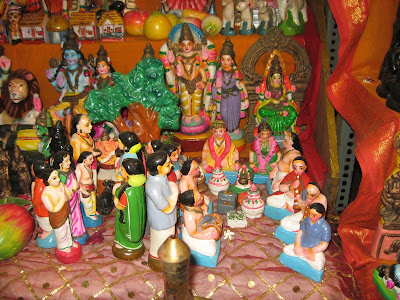
Here is the overall view.... there are two sets of steps which have been combined to keep all the dolls...
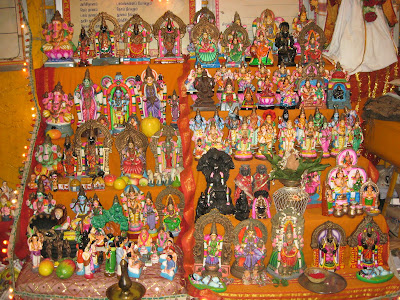
And here are some interesting dolls....
These are Samhith's favourites....
The houses.....
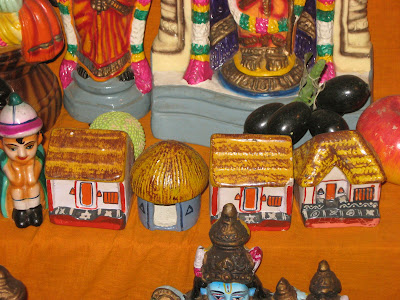
..... and this pumpkin!
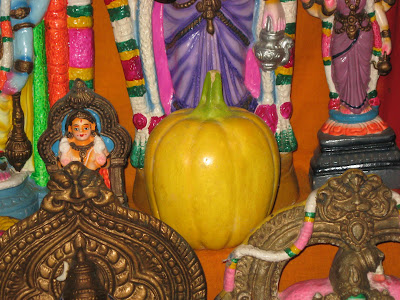
I liked this Dakshinamoorthi with his disciples - the four sages.
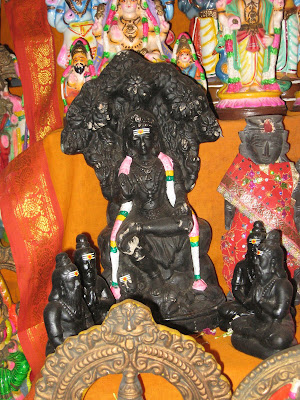
There are two sets here... one is the marriage set and the other is a group praying to a Ganesha near a tree.
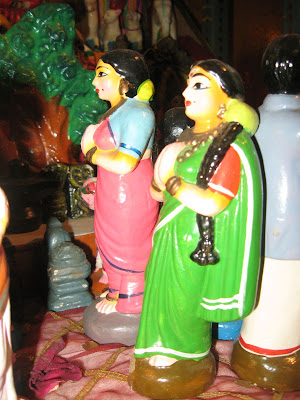
I loved these two dolls... one wearing a six yards saree and the other wearing the traditional nine yards one...
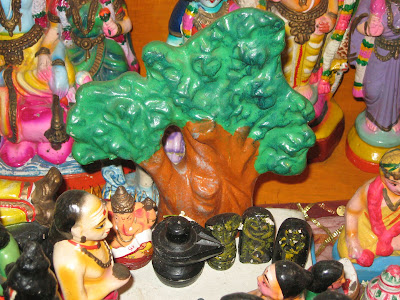
And here is a closer look at the tree. There are idols at the base, such as a Ganesha and a lingam. There are also four statuettes of snakes, a sight commonly seen in temples in Southern India. Wish I had one of these!
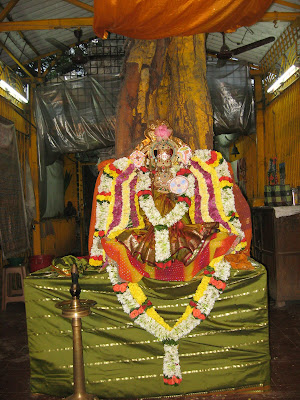
And finally, here is the Devi herself, all decked up for the evening pujas....
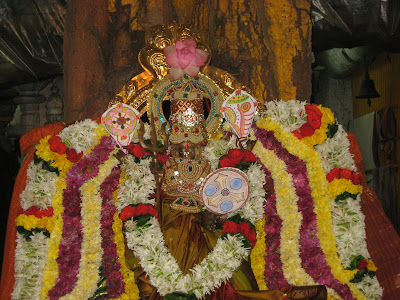
 A closer look at her...

Here is the overall view.... there are two sets of steps which have been combined to keep all the dolls...
And here are some interesting dolls....
These are Samhith's favourites....
The houses.....
..... and this pumpkin!
I liked this Dakshinamoorthi with his disciples - the four sages.
There are two sets here... one is the marriage set and the other is a group praying to a Ganesha near a tree.
I loved these two dolls... one wearing a six yards saree and the other wearing the traditional nine yards one...
And here is a closer look at the tree. There are idols at the base, such as a Ganesha and a lingam. There are also four statuettes of snakes, a sight commonly seen in temples in Southern India. Wish I had one of these!
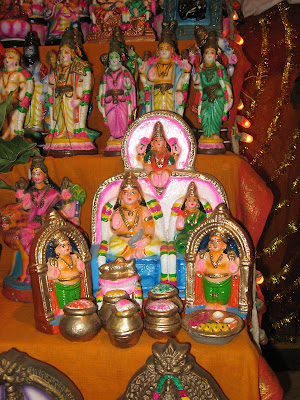
Here is a new set I have not seen before. This one depicts the Lakshmi Kubera Puja. The pair at the centre are Kubera, the God of wealth and his wife Sittarini. Above is Goddess Lakshmi, pouring Gold Coins, symbolizing wealth. On the two sides are Yakshas, and in front are pots of puffed rice and coins covered with sugar candy. To read more about Kubera Lakshmi, click here. Incidentally, there is a lotus placed in front of Kubera with a golden fish on it. I have been unable to find the significance of this, except that the fish is considered auspicious and signifies the presence of Lord Vishnu in Matsya avatar. If anyone can throw any light on this, please do write in and I shall update this post with your information.
And finally, here is the Devi herself, all decked up for the evening pujas....
Thats all for today....Lets see what tomorrow brings!
Lovely pictures all, I like the pumpkin.
ReplyDeleteThis is a grand Golu! Thanks for posting this.
ReplyDelete(To read more about Kubera Lakshmi, click here. - This is not hyperlinked).
:)
@Mridula: thanks... it was so real...
ReplyDelete@Bindhu: thanks so much.... seem to have missed linking it... have done it now!
Sooper
ReplyDeletewas just wishing I could take my kids to see an authentic Golu, and here is one... I shall show it to them surely
BTW where is yours in its completed version
sorry I somehow missed your first post on N...
ReplyDeletewonderful
By showcasing a golu each day, you are sparing us a temple visit. Lovedthe previous blogs. Excellent photos. will watch regularly.
ReplyDeleteVery colorful! You have started a wonderful series.
ReplyDelete