The Hindu and Buddhist history of Odisha , or rather, ancient Kalinga, is rather well known to everyone. Who hasn’t heard of the grand temples of Odisha – Puri, Lingaraj and Konark, or the great war of Kalinga which inspired Ashoka to convert to Buddhism? In contrast, very few know of the Jaina heritage of this region. This is quite a pity, since, just around 7 km from the city, is one of India’s most ancient inscriptions, which throws light on the Jaina heritage of Odisha. This inscription is the Hathigumpha inscription of Kharavela, in the hills of Udaygiri. Udaygiri and Khandgiri are two hills located opposite each other, and both are testaments to the rich Jaina heritage of Odisha. The caves at Udaygiri are older, while Khandgiri is relatively newer, but has lasted much longer, and continues to be a place of pilgrimage for Jains even today. These hills, from inscriptions and excavations of caves, shrines and rock beds, appear to have been a haven for Jaina monks, right from the ...
There are 12 temples inside the Mysore Palace complex. Some
of these are ancient ones, which stood long before the palace was built, while
others are relatively recent, having been built by the royal family in
different periods. Among these, it is the Shveta Varahaswamy Temple which is
the most prominent, since it is located right next to the present entrance to
the palace.
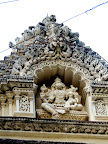 |
| Varaha over the main doorway |

Varaha is the third avatar or incarnation of Lord Vishnu,
the family deity of the Wodeyars. He appears in the form of a wild boar,bringing out the earth (Bhu-devi) from the ocean. The idol being made of white
stone, He is called ‘Shveta (white) Varahaswamy. It is said that the idol was
brought from Srimushnam in Tamilnadu, by Chikka Devaraja Wodeyar (1672-1704),
and consecrated at a new temple in Srirangapatna, which was then their capital.
In 1809, the deity was brought to Mysore and consecrated in this temple by
Diwan Purnaiah as per the wishes of Krishna Raja Wodeyar III.

The temple is built in the typical Hoysala style of
architecture with intricate work over the doorways and pillars.


There is also a
separate shrine for the goddess.

One of the interesting things about this
temple are the paintings representing the Ramayana and Bhagavata on the walls
of the pillared hall. Unfortunately, cameras aren’t allowed inside the temple,
so I have no photos of these. Instead, here is a depiction of the Dashavatar
(the 10 incarnations of Lord Vishnu) over the doorway…
 |
| Narasimha... killing the demon Hiranyakasipu |
 |
| Narasimha in a different pose... as Lakshmi Narasimha accompanied by smaller ircons of Dashavatars... the one on the left is Vamana. I cant identify the one on the right. Looks a bit like Garuda. |
 |
| Some of the Dashavatars/.. the central one is Rama. see the smaller icons of Matsya, Kurma and Varaha |
I am sharing this post today with SkyWatch Friday. True, there isnt much of the sky in these pics, but standing in the palace complex, looking around, the temples with their majestic gopurams were the most visible on the skyline! For more beautiful skies from around the world, visit the Skywatch page.

Wow, Gorgeous! Indeed, extraordinary architecture...like your tour.
ReplyDeleteReally, you have an Amazing Blog, Anu! I glad that found your blog and continually enjoying your new posts and/or a follower at your blog. but now I hope, you'll be a follower and commenter. Indeed, I have also very informative and interesting blog..Have a nice day..
Thanks so much. I havent been able to see a lot of blogs recently, but when i start to catch up, I surely will read yours. hope to keep seeing u here.
DeleteVery beautiful photos for SWF!Have a nice weekend.
ReplyDeleteThank you, Steffi! have a grt weekend too!
DeleteBeautifully covered. I have been wanting to do this for long now.
ReplyDeleteThanks Rajesh! would love to read your impressions of the temple too.
DeleteWonderful architectures. Nice shots.
ReplyDeletehttp://rajniranjandas.blogspot.in/