The Hindu and Buddhist history of Odisha , or rather, ancient Kalinga, is rather well known to everyone. Who hasn’t heard of the grand temples of Odisha – Puri, Lingaraj and Konark, or the great war of Kalinga which inspired Ashoka to convert to Buddhism? In contrast, very few know of the Jaina heritage of this region. This is quite a pity, since, just around 7 km from the city, is one of India’s most ancient inscriptions, which throws light on the Jaina heritage of Odisha. This inscription is the Hathigumpha inscription of Kharavela, in the hills of Udaygiri. Udaygiri and Khandgiri are two hills located opposite each other, and both are testaments to the rich Jaina heritage of Odisha. The caves at Udaygiri are older, while Khandgiri is relatively newer, but has lasted much longer, and continues to be a place of pilgrimage for Jains even today. These hills, from inscriptions and excavations of caves, shrines and rock beds, appear to have been a haven for Jaina monks, right from the ...
The name ‘Hazara Rama Temple’ makes you wonder – a thousand Ramas? Would there have been a thousand idols of Rama here? Or just a thousand carvings depicting Rama? And why the word ‘Hazara’, which has its origins in Urdu, and not ‘Sahasra’ – which is the Sanskrit equivalent? Or is it simply a corruption of the word? As it turns out, though there are a thousand (or more) depictions of Lord Rama on the walls of this small, but beautiful temple, the name might have something to do more with its location than the Lord it was built for. ‘Hazaramu’ is the Telugu word for audience hall or the entrance hall of a palace, which is where this temple is located. This might have been the private temple of the Vijayanagara kings, which is probably why it is not as huge as the other temples in the city.
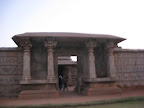
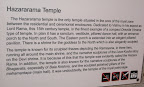
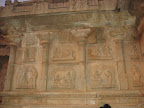
This is one of the few temples where every inch of the outer wall is filled with carvings depicting scenes from the Ramayana. By the time we visited this temple, it was already dark, and my camera could not really succeed in bringing out the beauty of the individual panels….
 |
| Most of the scenes on the outer wall depict elephants and horses - at least thats what we could see in the dark! They looked like armies.... Rama's army??? |
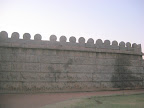


Left to me, I could have spent hours poring over each panel, identifying the scenes depicted on them, and telling Samhith the story, besides of course, photographing each and every one of them!
 |
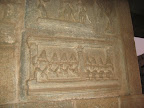
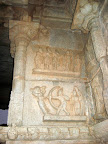
| Scenes from the Ramayana on the inner wall.... If I had time, I would have photographed scenes separately so that I could have written this post in the form of the story.... Another time :( |

 |
| There arent only scenes from the Ramayana... Krishna figures too, quite prominently... |


 |
| and here is one of Mahishasura Mardini |
However, it was already dark, and the fact that the temple was empty except for our group only heightened the eeriness already present…..
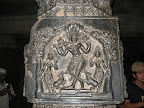
Probably it was the almost complete darkness in the sanctum, which had some beautifully carved pillars I managed to capture……
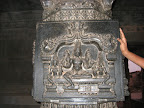 |
| Vishnu - with Sridevi and Bhudevi |

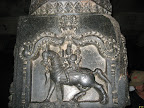 |
| This, it seems is Kalki... I love this representation on a horse instead of the ones we see today with a horse-face! |
 |
| Hanuman |
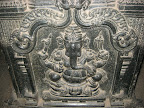 |
| Ganesha |

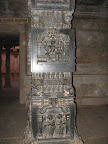
Or probably it was the destruction that the temple had experienced when the invaders had hacked at the head of every single figure on the gopuram…..

There was something about the temple which prevented me wandering off alone with my camera, as I normally do, and I stuck with our group, keeping in mind that the next time I was here, I would make it a point to keep at least half a day aside for this temple alone!

Related articles

- Hampi Part 2 - Stones do Speak - A Photo feature
- Hampi Part 3 - A Short History of the Vijayanagara Empire
- Hampi Part 4 - The Virupaksha Temple
- Hampi Part 5 - The Hampi Bazaar
- Hampi Part 6 - Krishna Temple
- Hampi Part 7 - Vitthala Temple
- Hampi Part 8 - Narasimha and Badavalinga
- Hampi Part 9 - Hazara Rama Temple
The panels on the outer wall may not be Lord Rama's army. In fact if you notice it appears in one of the panels next to the gate certain horse traders who appear like Arabs are showing the horses to a stately nobleman /King.
ReplyDeletequite possible!! i am only a layman when it comes to this!
ReplyDeleteNice. Truly knowing Hampi I think will take a lifetime.
ReplyDelete